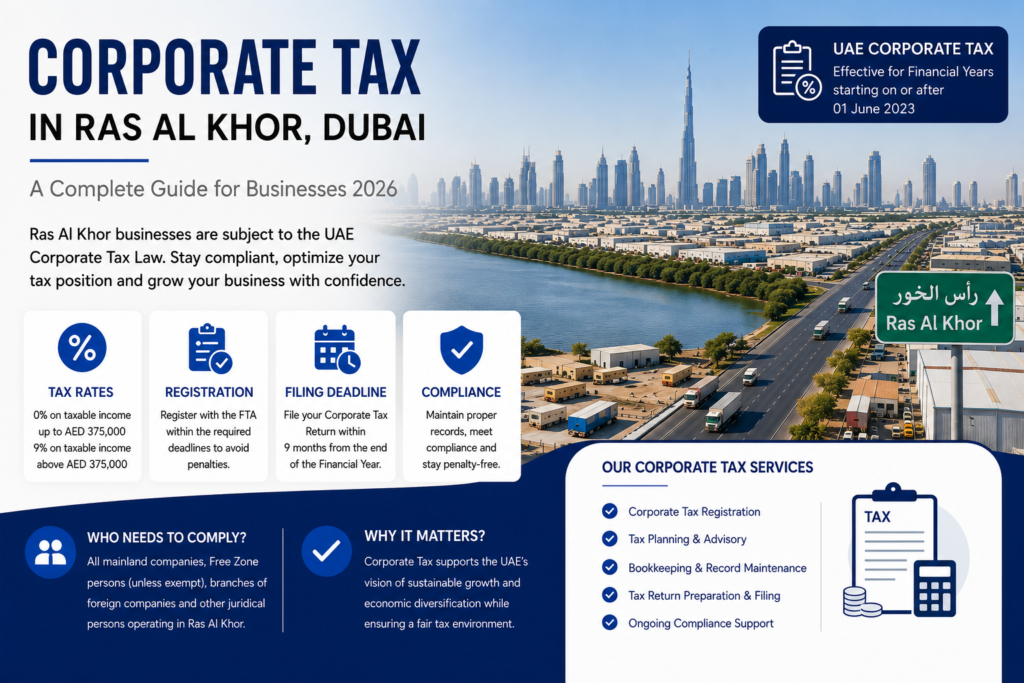
Corporate Tax in Ras Al Khor, Dubai 2026: Registration, Rates, Filing & Compliance Guide
Corporate Tax in Ras Al Khor, Dubai
Businesses operating in Ras Al Khor, Dubai are subject to the UAE Corporate Tax rules applicable to their business structure, taxable income and activities. UAE Corporate Tax generally applies at 0% on taxable income up to AED 375,000 and 9% on taxable income exceeding AED 375,000. The tax applies from the beginning of the first financial year starting on or after 1 June 2023
Ras Al Khor is an important commercial and industrial area of Dubai, with businesses involved in trading, manufacturing, automotive activities, logistics, warehousing, construction-related services and other commercial operations. These businesses should evaluate their Corporate Tax registration, accounting records, taxable income, deductions and filing obligations based on their individual circumstances.
Quick Answer: What is Corporate Tax in Ras Al Khor?
Corporate Tax in Ras Al Khor follows the UAE federal Corporate Tax system. Taxable income up to AED 375,000 is generally taxed at 0%, while taxable income above AED 375,000 is generally subject to 9%, subject to the applicable UAE Corporate Tax rules, exemptions and reliefs.
Corporate Tax is not a separate Ras Al Khor tax. It is a federal UAE tax, meaning businesses in Ras Al Khor generally follow the same Corporate Tax framework that applies across Dubai and the UAE.
What Is UAE Corporate Tax?
UAE Corporate Tax is a federal tax imposed on the taxable income of businesses and other taxable persons under the UAE Corporate Tax Law.
The Corporate Tax regime was introduced under Federal Decree-Law No. 47 of 2022 on the Taxation of Corporations and Businesses, with the first tax periods beginning on or after 1 June 2023 coming within the regime.
The purpose of the UAE Corporate Tax framework is to establish a modern business taxation system while maintaining the UAE’s position as a competitive international business and investment hub.
For a business in Ras Al Khor, Corporate Tax compliance can involve:
- Corporate Tax registration
- Determining taxable income
- Maintaining accounting and financial records
- Reviewing deductible and non-deductible expenses
- Assessing applicable exemptions and reliefs
- Evaluating related-party transactions
- Preparing Corporate Tax returns
- Paying Corporate Tax where applicable
- Maintaining supporting documentation
The actual tax liability depends on the business’s taxable income rather than simply its gross sales or turnover.
What Is the Corporate Tax Rate in Ras Al Khor?
The standard UAE Corporate Tax rate is 0% on taxable income up to AED 375,000 and 9% on the portion of taxable income exceeding AED 375,000
For example:
| Taxable Income | Applicable Rate |
|---|---|
| AED 200,000 | 0% |
| AED 375,000 | 0% |
| AED 500,000 | 9% on the amount above AED 375,000 |
| AED 1,000,000 | 9% on the amount above AED 375,000 |
| AED 2,000,000 | 9% on the amount above AED 375,000 |
The AED 375,000 threshold applies to taxable income, not automatically to total business revenue.
Example
Suppose a Ras Al Khor company has:
- Revenue: AED 2,000,000
- Allowable business expenses: AED 1,500,000
- Taxable income: AED 500,000
The first AED 375,000 is subject to 0%, while the remaining AED 125,000 is generally subject to 9%.
Therefore:
AED 125,000 × 9% = AED 11,250 Corporate Tax
This simplified example demonstrates why businesses should calculate taxable income rather than assuming that Corporate Tax is simply 9% of annual sales.
Who Needs Corporate Tax Registration in Ras Al Khor?
Businesses in Ras Al Khor that fall within the UAE Corporate Tax regime generally need to register with the Federal Tax Authority (FTA) and obtain a Corporate Tax Registration Number.
The FTA’s Corporate Tax registration service is available through EmaraTax. The registration process involves creating or accessing an EmaraTax account, creating a taxable person profile and submitting the Corporate Tax registration application.
Businesses that may need registration include:
- Mainland companies
- UAE-incorporated companies
- Certain free zone companies
- Businesses operated by natural persons when the relevant conditions are met
- UAE branches in circumstances covered by the Corporate Tax rules
- Other taxable persons falling within the legislation
For natural persons conducting business activities in the UAE, the FTA states that Corporate Tax registration is generally required when annual business revenue exceeds AED 1 million in a calendar year. Salary, private investment income and real estate investment income are excluded from the calculation of that threshold under the stated rules.
Corporate Tax Registration in Ras Al Khor
Corporate Tax registration is an important first step for businesses that fall within the UAE Corporate Tax regime.
The FTA provides Corporate Tax registration through EmaraTax. The basic online process includes:
- Create and activate an EmaraTax account.
- Access the EmaraTax dashboard.
- Create a taxable person profile.
- Open the relevant taxable person account.
- Select Corporate Tax registration.
- Complete the required information.
- Upload the required documents.
- Submit the application for FTA review.
Businesses should not wait until the Corporate Tax return deadline to determine whether registration is required. Registration deadlines depend on the type of taxable person and applicable circumstances.
The FTA has also clarified specific registration timelines for different categories of juridical and natural persons.
What Happens If Corporate Tax Registration Is Late?
Late Corporate Tax registration can result in an administrative penalty of AED 10,000. The FTA currently also provides a penalty-waiver initiative subject to specific conditions, including filing the first Corporate Tax return or applicable annual declaration within seven months from the end of the first tax period.
This does not mean businesses should intentionally delay registration. A Ras Al Khor company should first determine its registration obligation and deadline and complete the process within the applicable timeframe.
When Does a Ras Al Khor Business File Its Corporate Tax Return?
A UAE Corporate Tax return generally needs to be submitted within nine months from the end of the relevant Tax Period. Corporate Tax due must also be paid within the applicable statutory timeframe. The FTA reiterated this requirement in September 2026.
For example, if a company’s Tax Period ends on 31 December 2025, its Corporate Tax return and applicable tax payment would generally be due by the end of September 2026.
The exact deadline should always be checked against the company’s tax period and applicable FTA requirements.
How Is Corporate Tax Calculated in Ras Al Khor?
Corporate Tax calculation starts with the business’s accounting results and then applies the relevant UAE Corporate Tax rules.
A simplified process is:
Accounting profit → Tax adjustments → Taxable income → Applicable reliefs/rules → Corporate Tax liability
Businesses should review items such as:
- Business revenue
- Cost of goods sold
- Employee costs
- Rent
- Professional fees
- Depreciation
- Finance costs
- Entertainment expenses
- Related-party transactions
- Exempt income
- Other adjustments required under UAE Corporate Tax rules
This is why Corporate Tax should not automatically be calculated as 9% of turnover.
For example, a trading company in Ras Al Khor may have AED 10 million in annual sales but substantially lower taxable income after considering its legitimate business costs and applicable tax rules.
Corporate Tax for Ras Al Khor Trading Companies
Ras Al Khor has a strong concentration of commercial and industrial businesses, including trading and wholesale operations.
A trading company should consider:
- Proper revenue recognition
- Inventory records
- Cost of goods sold
- Supplier invoices
- Customer invoices
- Bank reconciliations
- Import and export documentation
- Related-party transactions
- Accurate financial statements
- Corporate Tax adjustments
Strong bookkeeping is therefore an important part of Corporate Tax compliance.
A company that maintains incomplete accounts may find it difficult to establish its taxable income accurately or support its tax position during an FTA review.
Corporate Tax for Manufacturing and Industrial Businesses
Manufacturing and industrial businesses in Ras Al Khor may have more complex accounting requirements because they can deal with:
- Raw materials
- Production costs
- Machinery
- Depreciation
- Inventory
- Warehousing
- Employee costs
- Logistics
- Capital expenditure
- Intercompany transactions
Corporate Tax planning for such businesses should be integrated with proper financial reporting rather than treated as a year-end exercise.
Does Corporate Tax Apply to Free Zone Companies Near Ras Al Khor?
A free zone company is not automatically exempt from UAE Corporate Tax. However, a Qualifying Free Zone Person may benefit from a 0% Corporate Tax rate on Qualifying Income if it satisfies the applicable conditions.
This distinction is important.
Being registered in a free zone does not automatically mean that all income is taxed at 0%.
Free Zone businesses should determine:
- Whether they qualify as a Qualifying Free Zone Person
- Whether their income qualifies as Qualifying Income
- Whether they conduct excluded activities
- Whether they satisfy the applicable conditions
- Whether the de minimis requirements are satisfied
- Whether other income falls under the standard Corporate Tax regime
The Ministry of Finance has stated that certain non-qualifying revenue must remain within the applicable de minimis threshold, including the lower of 5% of total revenue or AED 5 million, subject to the detailed rules.
Small Business Relief for UAE Businesses
Eligible smaller businesses may be able to elect for Small Business Relief under the applicable rules.
The FTA states that resident persons may elect for Small Business Relief where revenue is AED 3 million or less in the relevant Tax Period and all previous Tax Periods ending on or before 31 December 2026, subject to the other conditions. Qualifying Free Zone Persons and certain members of multinational enterprise groups are excluded.
This is particularly relevant to small and medium-sized businesses operating in Dubai.
However, businesses should not assume that they qualify simply because their revenue is below AED 3 million. The full eligibility requirements need to be reviewed.
Corporate Tax Compliance Checklist for Ras Al Khor Businesses
A practical Corporate Tax compliance checklist includes:
1. Check Corporate Tax registration
Determine whether the company is required to register with the FTA.
2. Maintain proper accounting records
Keep invoices, receipts, bank statements, payroll records, contracts and other supporting documentation.
3. Prepare financial statements
Accurate financial statements provide the foundation for determining taxable income.
4. Calculate taxable income
Do not simply apply 9% to turnover. Calculate taxable income according to the applicable UAE Corporate Tax rules.
5. Review expenses
Identify deductible, partially deductible and non-deductible expenses where relevant.
6. Check related-party transactions
Businesses with related-party transactions should consider the applicable arm’s-length requirements and transfer pricing rules.
7. Determine applicable reliefs
Check whether Small Business Relief, Free Zone rules or other applicable provisions apply.
8. File the Corporate Tax return
Submit the return within the applicable statutory deadline.
9. Pay Corporate Tax
Where tax is due, make the payment within the prescribed timeframe.
10. Keep supporting records
Maintain documentation needed to support the company’s Corporate Tax position.
Corporate Tax Services in Ras Al Khor
Businesses that do not have an in-house tax team may work with a professional accounting and tax service provider for Corporate Tax compliance.
Corporate Tax support can include:
- Corporate Tax registration
- Tax registration assessment
- Corporate Tax return preparation
- Taxable income calculation
- Corporate Tax calculation
- Accounting and bookkeeping
- Financial statement preparation
- Tax compliance review
- Free Zone Corporate Tax assessment
- Small Business Relief assessment
- Tax documentation support
- Transfer pricing support
- Ongoing tax advisory
The appropriate service depends on the size, structure, industry and tax position of the business.
Corporate Tax in Dubai and Other UAE Business Locations
Businesses often operate across multiple Dubai and UAE commercial areas. Corporate Tax remains a federal UAE tax, so changing the business location from one Dubai area to another does not create a separate local Corporate Tax rate.
For businesses looking for services in other areas, related location pages can include:
Corporate Tax in Dubai
Dubai businesses can review Corporate Tax registration, filing, accounting and compliance requirements under the UAE federal tax framework.
Corporate Tax in Sharjah
Companies operating in Sharjah can use the same UAE Corporate Tax framework while assessing their own taxable income, registration requirements and filing obligations.
Corporate Tax in Abu Dhabi
Businesses in Abu Dhabi are also subject to the federal UAE Corporate Tax regime, with tax obligations determined according to the applicable Corporate Tax legislation.
Corporate Tax in JLT – Jumeirah Lakes Towers
JLT businesses, including professional service companies, trading businesses and corporate offices, should assess their Corporate Tax registration and filing requirements.
Corporate Tax in Business Bay
Businesses located in Business Bay can require Corporate Tax registration, accounting support, tax calculations and return filing depending on their status.
Corporate Tax in DIFC – Dubai
DIFC companies should carefully evaluate their Corporate Tax position because being established in a financial free zone does not automatically mean that every type of income qualifies for a 0% Corporate Tax rate.
Corporate Tax in Ajman
Businesses in Corporate Tax in Ajman follow the UAE federal Corporate Tax system and should assess their taxable status, registration and filing requirements.
Corporate Tax in Ras Al Khaimah
Companies operating in Ras Al Khaimah should also comply with the UAE Corporate Tax framework applicable to their business structure and activities.
Primary service location: Ras Al Khor, Dubai
Additional service areas: Dubai, Sharjah, Abu Dhabi, JLT, Business Bay, DIFC, Ajman and Ras Al Khaimah.
Why Businesses in Ras Al Khor Need Professional Corporate Tax Support
Corporate Tax compliance involves more than registering with the FTA.
A business may need to understand how its accounting profit translates into taxable income, which expenses can be considered under the tax rules, whether it qualifies for specific reliefs, how related-party transactions should be handled and when the return must be submitted.
Professional support can help businesses:
- Reduce avoidable compliance mistakes
- Maintain organized accounting records
- Identify potential tax adjustments
- Meet registration requirements
- Prepare Corporate Tax calculations
- Submit returns on time
- Understand applicable reliefs
- Maintain supporting documentation
The objective should not be to artificially reduce tax. Instead, businesses should structure their accounting and tax compliance so that the correct amount of Corporate Tax is calculated under UAE law.
Frequently Asked Questions About Corporate Tax in Ras Al Khor
What is the Corporate Tax rate in Ras Al Khor?
The UAE Corporate Tax rate is generally 0% on taxable income up to AED 375,000 and 9% on taxable income exceeding AED 375,000, subject to applicable rules and reliefs.
Is Ras Al Khor exempt from Corporate Tax?
No. Ras Al Khor does not have a separate Corporate Tax exemption. Businesses in Ras Al Khor are generally subject to the UAE federal Corporate Tax rules applicable to their business and tax status.
Is Corporate Tax based on revenue or profit?
Corporate Tax is generally determined using taxable income, not simply gross revenue. Accounting profit may need adjustments under UAE Corporate Tax rules before arriving at taxable income.
Do small businesses in Ras Al Khor pay Corporate Tax?
Some eligible businesses may benefit from Small Business Relief, subject to the applicable conditions. The FTA currently states a AED 3 million revenue condition for the relevant periods ending on or before 31 December 2026, alongside other eligibility requirements.
Do Ras Al Khor companies need Corporate Tax registration?
Businesses that fall within the UAE Corporate Tax registration requirements generally need to register with the Federal Tax Authority and obtain a Corporate Tax Registration Number.
What is the penalty for late Corporate Tax registration?
The FTA states that the administrative penalty for late Corporate Tax registration is AED 10,000, although a penalty-waiver initiative is available in qualifying circumstances subject to its conditions.
When is the Corporate Tax return due?
A Corporate Tax return generally must be filed within nine months from the end of the relevant Tax Period.
Is a free zone company in Dubai automatically taxed at 0%?
No. A free zone company must meet the applicable conditions to qualify for the 0% rate on Qualifying Income. Other income may be subject to the standard Corporate Tax rules.
Can a company in Ras Al Khor use Small Business Relief?
Potentially, if it satisfies all applicable conditions. Small Business Relief is not automatically available to every company with low revenue, and certain taxpayers, including Qualifying Free Zone Persons, cannot elect for it.
Does Corporate Tax apply to companies in Business Bay, JLT and DIFC?
Corporate Tax is a federal UAE tax. Businesses in Business Bay, JLT, DIFC and other UAE locations need to determine their Corporate Tax obligations according to their legal structure, activities, income and applicable rules.
Do I need an accountant for Corporate Tax in Ras Al Khor?
A business can manage its own compliance where it has the necessary expertise and systems. However, professional accounting and tax support can be useful for businesses with complex transactions, significant revenue, related-party transactions, free zone structures or multiple business activities.
Corporate Tax in Ras Al Khor: Get Your Business Ready
Corporate Tax compliance should be treated as an ongoing business process rather than a once-a-year task. Businesses in Ras Al Khor should maintain accurate accounts, monitor their taxable income, understand their registration obligations and prepare for filing before the deadline.
Whether your company operates in Ras Al Khor, Dubai, Business Bay, JLT, DIFC, Sharjah, Abu Dhabi, Ajman or Ras Al Khaimah, the correct Corporate Tax approach depends on the company’s individual circumstances.
If you are unsure whether your business needs to register, how much Corporate Tax may be payable, whether Small Business Relief applies, or whether your free zone income qualifies for the 0% regime, a Corporate Tax assessment can help establish the correct compliance position.
For businesses in Ras Al Khor, the first step is simple: determine your taxable status, complete Corporate Tax registration where required, maintain proper accounting records and prepare your Corporate Tax return within the applicable deadline.