UAE Corporate Tax Compliance: What Businesses Need to Keep in Mind
By QRS Global Auditing of Accounts L.L.C.
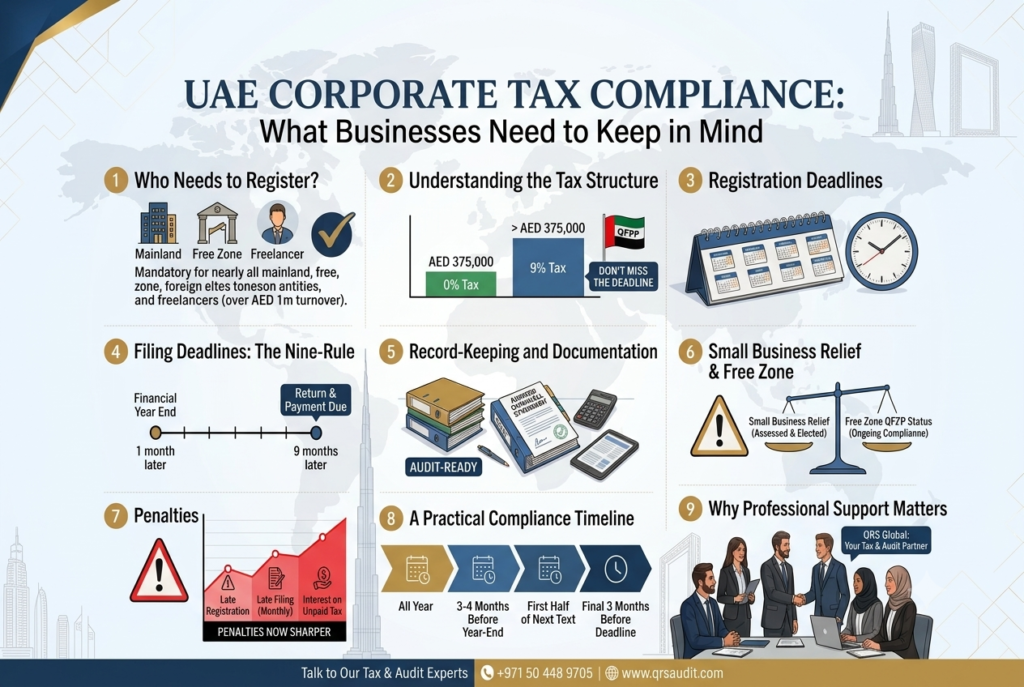
Most businesses in the UAE have now been through at least one Corporate Tax filing cycle. The rules aren’t brand new anymore, they’ve been in force since 2023 for the majority of companies. What has changed is how the FTA is enforcing them. In 2025 the approach was fairly forgiving — plenty of businesses registered late and got away with warnings or waivers. That leniency is thinning out. Inspections nearly doubled year on year, penalty rules were rewritten in April 2026, and companies that treat this as an annual scramble are starting to feel it in ways they weren’t before.
Below is a practical rundown of what matters for compliance right now.
1. Who Needs to Register for Corporate Tax?
Almost every business operating in the UAE corporate tax , honestly. Mainland companies, free zone entities, foreign firms with any real UAE footprint, freelancers who bill over AED 1 million a year — they all fall under the registration requirement, regardless of whether they end up owing anything.
That last point trips people up constantly. A company can be perfectly certain it owes 0% tax and still get fined for not registering. The FTA treats registration and tax liability as two completely separate obligations, and a lot of small business owners find that out the hard way.
Broadly, registration applies to:
- Mainland companies, no matter the size
- Free zone entities, including those that expect 0% treatment
- Foreign companies earning UAE-sourced income or with a permanent establishment here
- Sole proprietors and freelancers once turnover crosses AED 1 million
- Exempt entities, which in most cases still need to register and file a declaration
Representative offices are the one real carve-out, and even they’re only exempt as long as their activities don’t cross into something that counts as a Permanent Establishment.
2. Understanding the Tax Rate Structure
The rate itself isn’t the hard part. It’s:
- 0% on taxable income up to AED 375,000
- 9% on whatever’s above that
- Qualifying Free Zone Persons can hold onto 0% on qualifying income, provided they actually meet the substance and activity requirements
So say a business nets AED 500,000 in taxable profit for the year. The first AED 375,000 sits at zero. The remaining AED 125,000 gets taxed at 9%, coming to AED 11,250 owed. That part’s just arithmetic. Getting to an accurate taxable income figure in the first place is usually where the real work is.
Something free zone companies often miss: qualifying for 0% isn’t a one-time achievement. You have to keep meeting the conditions every single period. Slip into non-qualifying income even briefly and it can affect your treatment for that whole tax period.
3. Registration Deadlines: Don’t Assume You Have Time
Deadlines vary depending on entity type, and for a lot of businesses, the exact date comes down to when the trade license was issued.
- Resident companies typically follow a schedule tied to license issuance month, per FTA Decision No. 3 of 2024
- Businesses set up on or after 1 March 2024 get three months from establishment to register
- Freelancers who crossed AED 1 million in turnover during 2025 needed to register by 31 March 2026
- Non-resident companies with a UAE permanent establishment have three months from when that PE started existing
Miss it and penalties can apply even when zero tax is due. This is one of the more common — and avoidable — mistakes we see.
4. Filing Deadlines: The Nine-Month Rule
Once registered, filing follows a single rule across nearly all taxable persons: returns and payment are due nine months after the end of the financial year.
For a calendar-year business with a financial year ending 31 December 2025, that puts the deadline at 30 September 2026. For one ending 31 March 2026, it’s 31 December 2026.
One detail that surprises people: getting a filing extension approved doesn’t automatically extend the payment deadline too. Interest can still build up on unpaid tax during that window, extension or not.
5. Record-Keeping and Documentation
This is usually where things quietly go wrong. The FTA isn’t only checking the final number on the return anymore. In 2026 they’ve been actively matching filed figures against audited financial statements and supporting schedules, and gaps show up fast.
Businesses generally need to have on hand:
- Bookkeeping that’s reconciled properly, not assembled at the last minute
- Audited financial statements, required once revenue hits AED 50 million, and also for anyone claiming QFZP status
- Employment records — contracts, payslips, and for mainland businesses, Wage Protection System confirmations
- Transfer pricing documentation if related-party transactions cross the applicable thresholds
- Schedules that reconcile the tax return back to the underlying accounts
And keep in mind the FTA can request records in Arabic. It’s not common, but it happens.
6. Small Business Relief and Free Zone Considerations
Small Business Relief can genuinely reduce the compliance burden for businesses under a certain revenue level, but it isn’t automatic. It has to be assessed and elected properly, and some elections can’t be reversed once made. Assuming eligibility without checking is a mistake worth avoiding.
Free zone companies face a similar decision — 0% QFZP treatment versus the standard 9% regime. Because that classification carries through the whole tax period, it’s worth reviewing income sources and activities carefully before filing rather than discovering an issue afterward.
7. Penalties: The Cost of Getting It Wrong
Cabinet Decision No. 129 of 2025, effective April 2026, brought Corporate Tax penalties into line with how VAT and excise violations are handled. In practice, businesses are now looking at:
- Fixed penalties for registering late
- Monthly-accumulating penalties for late filing
- Interest charged on unpaid tax
- Additional penalties layered on for inaccurate or incomplete returns
There’s been a waiver program helping businesses that registered late get compliant, and a large number have used it. But relying on that as a fallback plan isn’t a great strategy going forward — better to just meet the deadlines.
8. A Practical Compliance Timeline
For a business on a standard calendar-year financial period, this kind of schedule tends to hold up:
- All year: keep the books reconciled, track related-party dealings, keep an eye on QFZP or Small Business Relief eligibility
- 3–4 months before year-end: begin audit prep, if an audit is required
- First half of the following year: finalize the financial statements, complete the audit, work out taxable income
- Final three months before the deadline: settle on your regime election, file through EmaraTax, and pay — not in the last week if you can help it
Businesses that spread this work across the year, rather than compressing it into a few weeks before the deadline, tend to have far fewer surprises.
9. Why Professional Support Matters
At this point Corporate Tax touches nearly every corner of a business’s finances — bookkeeping, payroll, related-party transactions, audit readiness, elections that lock you into a position for the full year. As enforcement keeps tightening, there’s less room to get any of it wrong.
That’s really the value a licensed audit and accounting firm brings — not just showing up at filing time, but staying involved in how the records are kept all year round.
Stay Compliant, Stay Confident
At QRS Global Auditing of Accounts L.L.C., we support mainland and free zone businesses across the corporate tax UAE requirements through the full Corporate Tax cycle — registration, bookkeeping, audit preparation, return filing, and ongoing advisory — so deadlines stop being something you have to think about.
Talk to Our Tax & Audit Experts →
Disclaimer: This article is for general informational purposes and doesn’t constitute tax or legal advice. Your specific obligations depend on your entity structure, license, and financial year — speak with a licensed tax advisor for guidance tailored to your business.