Top Audit Firms in Dubai & UAE (2026 Guide): , Pricing, and How to Choose the Right Auditor
Choosing an audit firm in Dubai has become a critical decision for almost every UAE business. With Corporate Tax now requiring audited financial statements for companies earning over AED 50 million a year and mandatory audits for every Qualifying Free Zone Person regardless of revenue thousands of businesses are searching for an approved auditor in dubai, many for the first time.
This guide brings together everything you need to know: the top-rated firms, how pricing compares, how to vet a mainland auditor, what services to expect, and how DMCC and other free zone approvals work.
The UAE Audit Market at a Glance
Dubai’s audit market splits into three practical tiers:
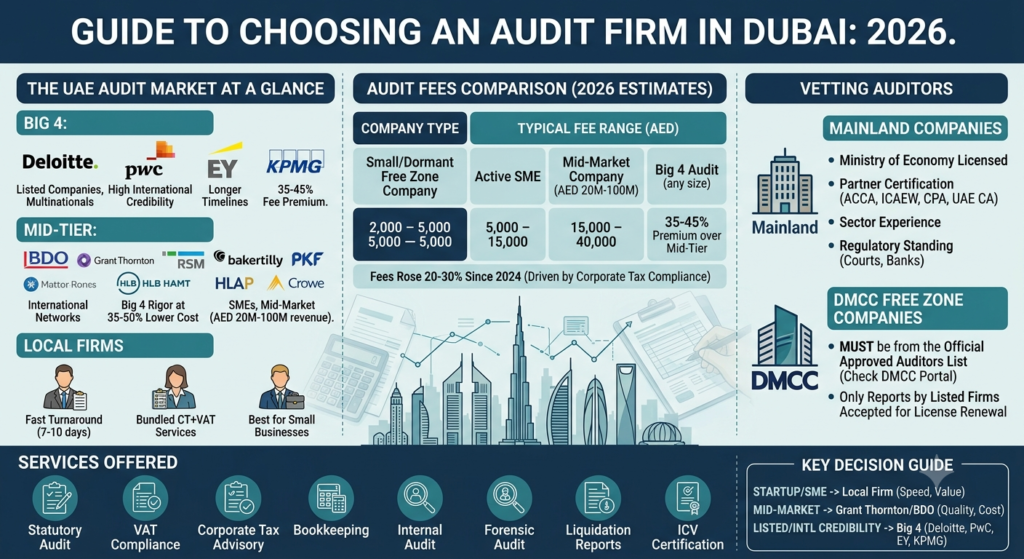
Big 4 Deloitte Middle East, PwC Middle East, EY UAE, and KPMG Lower Gulf. Best suited to listed companies, multinationals, and complex group structures that need international brand credibility with banks and investors.
Mid-tier international networks BDO, Grant Thornton, RSM, Baker Tilly, PKF, HLB HAMT, and Crowe. These offer Big 4-level rigor at 35–50% lower cost, and are a strong fit for mid-market companies (roughly AED 20–100 million in revenue).
Comparing Audit Service Providers for Small Businesses in the UAE
For a small business, the right auditor isn’t necessarily the biggest name — it’s the firm that offers:
- Turnaround time — local firms often complete SME audits in 7–10 days; Big 4 timelines are usually longer
- Bundled Corporate Tax + VAT services — most local and mid-tier firms now bundle Corporate Tax compliance into the standard audit package, adding only 15–20% to base fees, versus Big 4 firms charging 35–45% more for the same add-on
- Industry familiarity — an auditor who has handled your specific activity (retail, trading, real estate, professional services) will flag issues faster and reduce back-and-forth
- Free zone or mainland approval status — confirm the firm is actually authorized to sign your specific entity’s audit report
Audit Services Pricing Comparison in Dubai (2026 Estimates)
| Company Type | Typical Audit Fee Range (AED) |
|---|---|
| Small/dormant free zone company | 2,000 – 5,000 |
| Active SME (mainland or free zone) | 5,000 – 15,000 |
| Mid-market company (AED 20M–100M revenue) | 15,000 – 40,000 |
| Big 4 audit (any size) | 35–45% premium over mid-tier/local firms |
Audit fees across the market have risen roughly 20–30% since 2024, driven largely by the additional scope required for Corporate Tax compliance. Always request a firm-specific quote, as fees vary by industry complexity, transaction volume, and group structure.
How to Find Reputable Audit Firms for Mainland Companies
Mainland auditors don’t require free zone approval, but before engaging one, verify:
- Ministry of Economy licensing — the firm must be licensed as an audit practice under UAE law
- Partner certification — look for ACCA, ICAEW, CPA, or UAE CA-equivalent qualifications among the signing partners
- Sector experience — ask for references or case examples from your specific mainland activity, since disclosure and documentation requirements differ by sector
- Regulatory standing — reputable mainland firms are typically registered with UAE courts, prosecution authorities, and major banks, which supports smoother bank account and financing processes
DMCC Approved Auditors in Dubai
Companies licensed under the Dubai Multi Commodities Centre (DMCC) must appoint an auditor from DMCC’s official Approved Auditors List — only a report signed by a listed firm will be accepted by the Authority. This applies to all DMCC member companies except branches that already have a designated group auditor.
Key points:
- The list is maintained and updated by the DMCC Approved Auditor Advisory Panel
- Firms must hold a valid UAE auditing licence, qualified partners, and demonstrated audit experience to be added
- The list must be checked directly via the DMCC Member Portal (Compliance Services section) — many third-party blog copies of this list are outdated (some circulating PDFs date back to 2020)
- Big 4 firms, most mid-tier firms (BDO, Grant Thornton), and numerous local firms (Farahat & Co., SKM International, Saif Chartered Accountants, and others) appear on the current list
Every DMCC company must submit audited financial statements annually as a condition of licence renewal, using the “Company Audited Financial Statements Summary Sheet” template available through the DMCC Portal.
What Services Do Auditors in Dubai Typically Offer?
Beyond the core statutory audit, most firms provide:
- VAT compliance and filing
- Corporate Tax registration and advisory
- Bookkeeping and accounting
- Internal audit and risk advisory
- Forensic and fraud audits
- Liquidation reports
- ICV (In-Country Value) certification
- Payroll management
- Business setup support
Where to Book an Audit Consultation in Dubai
There’s no single centralized booking platform for audit consultations in the UAE. Most firms — from Big 4 to local practices — offer a free initial consultation through a “book a call” form on their website, or a direct phone/WhatsApp line. The practical approach:
- Shortlist 2–3 firms matching your company size and free zone/mainland status
- Request quotes and confirm they’re on the relevant approved auditors list (if applicable)
- Compare turnaround time alongside price before committing
Top Business Advisory Firms in Dubai
Beyond pure audit, many businesses — especially new entrants to the UAE — also need broader business advisory support: company formation, licensing, visas, and ongoing management consultancy. Firms commonly cited in this space include:
- Shuraa — business setup, taxation, and audit services under one roof
- Virtuzone — company formation and business setup consultancy, popular with startups and SMEs
- Creative Zone — business setup and licensing across UAE free zones and mainland
- Commitbiz — management consultancy, business formation, and regulatory compliance support
- Adam Global — auditing, management consulting, and tax advisory across the UAE
Note: CGCA Global also ranks itself #1 across nearly every “Top 10” category it publishes — audit, accounting, tax, risk consulting, chartered accountants, and business advisory alike. This is a consistent self-promotional pattern rather than an independent ranking, so weigh it accordingly alongside firms with third-party track records.
If your need is company formation/licensing rather than an annual audit, a business setup consultancy (Shuraa, Virtuzone, Creative Zone) is the right category to look at — not an audit firm. Many businesses end up using one firm for setup and a separate one for the annual audit, since the two are different specializations even when a firm markets both.
Quick Decision Guide
- Startup or SME wanting speed and value → a local firm on the relevant approved auditors list
- Mid-market company wanting Big 4 quality at lower cost → Grant Thornton or BDO
- Listed company or one needing international investor/bank credibility → Deloitte, PwC, EY, or KPMG
Frequently Asked Questions
What are the top 10 audit firms in Dubai? The top 10 audit firms in Dubai for 2026 are Deloitte, PwC, EY, KPMG, BDO, Grant Thornton, RSM, Baker Tilly, PKF, and Farahat & Co. The first four are the “Big 4” and suit large or listed companies; the rest offer comparable quality at lower cost and are better suited to SMEs and mid-market businesses.
What are the big 4 accounting firms in the UAE? The Big 4 accounting and audit firms in the UAE are Deloitte, PwC (PricewaterhouseCoopers), EY (Ernst & Young), and KPMG. They handle the largest share of listed-company and multinational audits in the country and typically charge 35–45% more than mid-tier or local firms for comparable audit scope.
How much does an audit cost in Dubai? Audit costs in Dubai range from roughly AED 2,000–5,000 for a small or dormant free zone company, AED 5,000–15,000 for an active SME, and AED 15,000–40,000 for a mid-market company earning AED 20–100 million. Big 4 firms typically charge 35–45% more than mid-tier or local firms for the same scope.
Who is a DMCC approved auditor? A DMCC approved auditor is an audit firm listed on the Dubai Multi Commodities Centre’s official Approved Auditors List, authorized to sign statutory audit reports for DMCC member companies. Only auditors on this list are accepted by the DMCC Authority; the current list must be checked via the DMCC Auditors in dubai Member Portal, not third-party websites.
How do I choose the right audit firm for a small business in the UAE? For a small business, prioritize an auditor with fast turnaround (7–10 days is typical for local firms), Corporate Tax and VAT services bundled into the audit package, experience in your specific industry, and confirmed approval status with your free zone or the Ministry of Economy for mainland companies.
Do mainland companies in Dubai need an approved auditor? Mainland companies don’t need free zone approval, but their auditor must be licensed by the UAE Ministry of Economy, have qualified signing partners (ACCA, ICAEW, CPA, or UAE CA-equivalent), and ideally be registered with UAE courts and major banks for smoother regulatory and financing processes.
What services do audit firms in Dubai offer besides the annual audit? Most Dubai audit firms also provide VAT compliance, Corporate Tax registration and advisory, bookkeeping, internal audit and risk advisory, forensic audits, liquidation reports, ICV certification, and payroll management — many now bundle Corporate Tax in uae into the standard audit package.
This guide reflects general 2026 market conditions in Dubai and the UAE. Audit fees, approved auditor lists, and regulatory requirements should always be verified directly with the relevant free zone authority or the firm in question before making a final decision.
FAQ
Q: How can I register my company for corporate tax in the UAE?
A: Create an account on the FTA’s EmaraTax portal, link your trade license, complete the registration form with business and shareholder details, upload required documents, and submit for approval. A registered tax agent can manage this entire process, from documentation to TRN issuance.
Q: What is the penalty for late registration of corporate tax in UAE?
A: A late registration penalty of AED 10,000 applies to businesses that miss their FTA-assigned deadline, regardless of tax liability. This applies even to companies with zero taxable income, making timely registration essential.
Q: When is corporate tax due for payment in the UAE?
A: Corporate tax payments are due within 9 months of the end of a company’s financial year. For example, a business with a financial year ending December 31 must file its return and pay any tax owed by September 30 of the following year.
Q: How much is the UAE corporate tax?
A: The UAE corporate tax rate is 9% on taxable income exceeding AED 375,000. Income below this threshold is taxed at 0%. Qualifying Free Zone Persons may continue to benefit from a 0% rate on qualifying income if conditions are met
Q: What is the minimum threshold for corporation tax in UAE?
A: The minimum taxable income threshold for UAE corporate tax is AED 375,000. Businesses with taxable income below this amount pay 0% tax, while income above it is taxed at the standard 9% rate, applying uniformly across mainland and free zone entities.
Q: How is UAE corporate tax calculated?
A: UAE corporate tax is calculated by taking a company’s net taxable income (after allowable deductions) above AED 375,000 and applying a 9% rate; income up to that amount is taxed at 0%
Q: Is corporate tax zero in Dubai?
A: Corporate tax is not entirely zero in Dubai, but businesses with taxable income up to AED 375,000 pay 0% tax. Qualifying Free Zone Persons meeting specific conditions may also enjoy 0% tax on qualifying income, though registration remains mandatory regardless of the rate applied
Q: Who is liable to pay corporate tax in the UAE?
A: All UAE mainland companies, free zone businesses, and foreign entities conducting business in the UAE are generally liable for corporate tax, unless specifically exempt, such as government entities or qualifying public benefit organizations.
Q: What is qualifying income for UAE corporate tax?
A: Qualifying income refers to income earned by a Qualifying Free Zone Person from approved activities and transactions with other free zone entities or foreign parties, which may be eligible for the 0% corporate tax rate. Income from excluded activities or mainland transactions is generally taxed at the standard rate.
Q: Who is exempt from corporate tax in the UAE?
A: Entities exempt from UAE corporate tax include government entities, government-controlled entities, certain extractive and non-extractive natural resource businesses, qualifying public benefit organizations, and qualifying investment funds. Most other businesses, including free zone companies, must still register even if their effective tax rate is 0%
Q: How often must businesses file corporate tax returns in the UAE?
A: Businesses in the UAE must file a corporate tax return once per financial year, typically within 9 months of the financial year-end. Unlike VAT, corporate tax returns are not filed quarterly or monthly, but accurate bookkeeping throughout the year is required to support the annual filing.
Q: How do I know my corporate tax period?
A: Your corporate tax period is generally your company’s financial year, as stated in your trade license or incorporation documents. Most UAE businesses follow either a calendar year (January–December) or a custom fiscal year approved by the FTA, which determines filing and payment deadlines.
Q: When did corporate tax start in the UAE?
A: UAE corporate tax came into effect for financial years starting on or after June 1, 2023. Businesses with a financial year beginning June 1, 2023, became subject to corporate tax from that date, while those following a calendar year became liable from January 1, 2024.
This guide is maintained and reviewed by the QRS Content Team at QRS Global Auditing of Accounts L.L.C, a registered tax agency in the UAE. Figures referenced (9% rate, AED 375,000 threshold, AED 10,000 penalty) should be verified against the latest official FTA circulars, as they are subject to periodic update. For a personalized corporate tax registration consultation, contact our team.