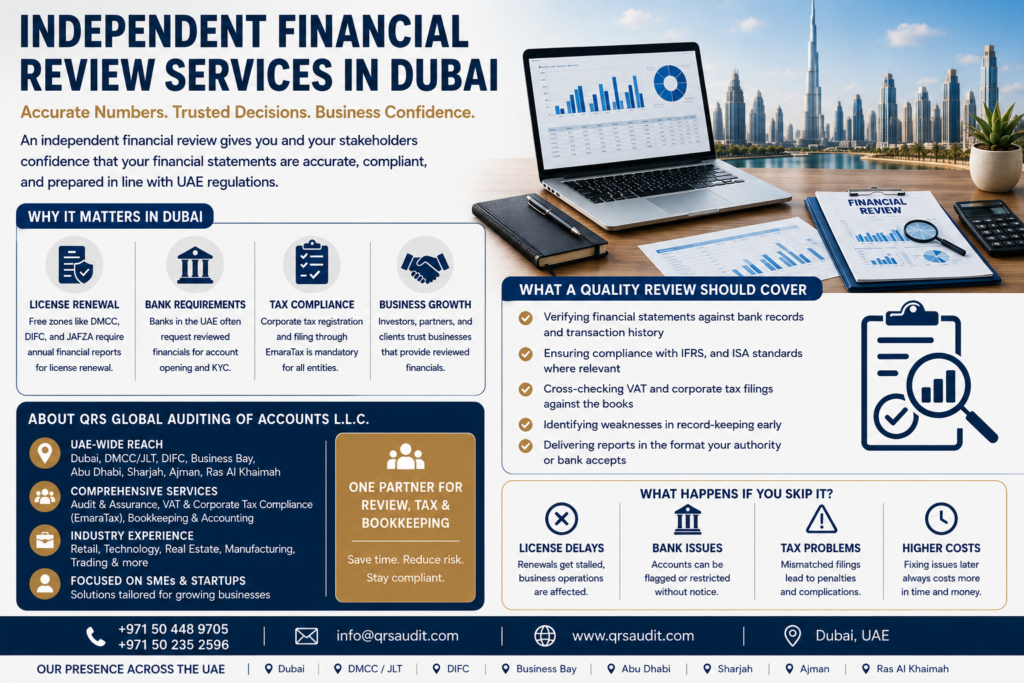
If you run a small business in Dubai, chances are you’ve come across the term “independent financial review” somewhere a bank asked for one, a free zone mentioned it in a renewal email, or a partner brought it up before signing a deal. Let’s actually break down what it means, why it matters for a business your size, and what a firm doing this work well actually looks like.
First, What Is an Independent Financial Review?
In simple terms, it’s an outside, licensed party looking at your financial statements and confirming they’re accurate separate from whoever handles your day-to-day bookkeeping. The word “independent” is the whole point. Your own accountant can tell you your books look fine. A bank or authority wants to hear that from someone with no stake in the answer.
It sits a step below a full statutory audit in terms of depth, but it serves the same basic function: giving whoever’s asking a b ank, a regulator, an investor a reason to trust your numbers without re-checking everything themselves.
Why This Matters More in Dubai Than in a Lot of Other Places
A few things about how business works here make this less optional than it might seem elsewhere:
- Free zones such as DMCC, JAFZA, and DIFC generally expect an annual financial report before renewing a trade license. Miss it, and the renewal can stall completely.
- Corporate tax registration through EmaraTax is mandatory now for almost every entity, including free zone companies sitting at a 0% rate. Filing without properly reviewed numbers tends to create more friction than it’s worth.
- UAE banks have gotten stricter with KYC and anti-money-laundering checks, and reviewed financials often come up as a requirement for opening or maintaining an account.
- Investors, partners, and even larger clients increasingly want to see reviewed financials before committing to anything meaningful.
None of these situations care much whether your company has five employees or five hundred. A small business just tends to feel the disruption faster when something stalls.
What a Review Should Actually Cover
Not every provider does this the same way, so it helps to know what belongs in a review that’s worth paying for:
- Checking your financial statements against actual bank records and transaction history, not just the ledger as it stands
- Confirming alignment with IFRS, and ISA standards where relevant
- Cross-checking VAT and corporate tax filings against the books, since mismatches there tend to surface eventually
- Flagging weak points in your record-keeping before they become real problems
- Delivering the report in the format your specific authority or bank actually accepts
That last point trips people up more than expected
a review formatted for the wrong authority just gets rejected, and now the deadline is closer than before.