Corporate Tax Registration in UAE: Complete Guide for Businesses
Corporate Tax Registration in UAE is an important compliance requirement for businesses and legal entities that fall within the UAE Corporate Tax framework. The process involves determining whether a business is required to register, preparing the necessary information, completing registration through the Federal Tax Authority (FTA), and maintaining ongoing tax compliance.
For UAE businesses, registration is only the beginning. Companies must also understand taxable income, filing requirements, applicable deadlines, record-keeping responsibilities, and potential penalties.
In this guide, QRS Global Auditing of Accounts L.L.C explains the UAE Corporate Tax registration process, eligibility, documents, deadlines, penalties, free zone considerations, and common compliance questions in a clear, practical format.
What Is Corporate Tax in the UAE?
Corporate Tax is a federal tax imposed on the taxable income of businesses and other entities that fall within the UAE Corporate Tax regime.
The UAE Corporate Tax regime generally applies to financial years beginning on or after 1 June 2023.
The standard Corporate Tax rates are:
0% on taxable income up to AED 375,000
9% on taxable income exceeding AED 375,000
Corporate Tax is based on taxable income rather than simply the total revenue generated by a company. Applicable deductions, exemptions, adjustments, and other rules must therefore be considered when determining the final taxable amount.
Accurate bookkeeping and financial records are essential because the quality of a company’s accounting information directly affects the accuracy of its tax calculations and reporting.
Quick Answer: What Is UAE Corporate Tax?
UAE Corporate Tax is a federal tax on the taxable income of businesses and other taxable entities. The standard rate is 9% on taxable income exceeding AED 375,000, subject to the applicable UAE Corporate Tax rules.
Who Needs Corporate Tax Registration in UAE?
Businesses should assess their Corporate Tax obligations according to their legal structure, business activities, income, and status under UAE tax legislation.
The framework can apply to various businesses and legal entities, including:
UAE-incorporated companies
Mainland businesses
Certain free zone companies
UAE branches of foreign companies
Certain individuals conducting business activities
Other entities that fall within the taxable-person rules
However, the tax treatment is not identical for every entity. Certain organizations and income categories may qualify for specific exemptions or treatment under the UAE Corporate Tax framework.
For this reason, businesses should assess their individual circumstances rather than assuming that all companies have the same registration or tax obligations.
Does Every UAE Business Have to Pay Corporate Tax?
Not necessarily. Whether Corporate Tax is payable depends on the applicable rules, taxable income, entity status, exemptions, and other relevant factors.
A business should separately consider whether it has a registration obligation, a filing obligation, and an actual tax payment liability. These are related but different compliance matters.
Corporate Tax UAE Eligibility
Understanding corporate tax UAE eligibility is an important first step before registering with the FTA.
A business should consider factors such as:
Its legal structure
Place of establishment
Business activities
Nature of income
Taxable income
Financial year
Applicable exemptions
Free zone status
Relevant UAE Corporate Tax rules
Free zone businesses should pay particular attention to their tax position. Establishing a company in a UAE free zone does not automatically mean that the business is outside the Corporate Tax regime.
Companies with international transactions, related-party arrangements, multiple activities, or complex structures may require a more detailed assessment.
How to Register for Corporate Tax in UAE
The Corporate Tax Registration in UAE process is completed through the Federal Tax Authority’s online tax services.
Although requirements can vary depending on the taxable person, the registration process generally involves several important stages.
Step 1: Determine Whether Registration Is Required
The first step is to establish whether the company falls within the UAE Corporate Tax regime and whether it has a registration requirement.
This assessment should consider the entity’s legal structure, activities, financial year, and applicable tax rules.
Step 2: Prepare Company Information
Businesses should prepare accurate corporate and identification information before starting the application.
Depending on the company, this may include:
Valid trade licence
Company incorporation information
Business activities
Ownership information
Authorized signatory details
Contact information
Identification documents
Supporting corporate documents
The exact documentation can vary according to the company’s legal structure.
Step 3: Access the FTA Tax System
The business or its authorized representative can access the relevant FTA online services and establish or use the required tax account.
All information should be entered accurately. Differences between official company documents and submitted tax information can cause unnecessary compliance issues.
Step 4: Submit the Registration Application
The company submits the requested information through the FTA system.
Before submission, businesses should carefully review:
Legal entity details
Trade licence information
Contact details
Ownership information
Authorized representative information
Financial year information
Step 5: Receive Corporate Tax Registration Details
Once the application is processed, the business receives its relevant Corporate Tax registration details.
These details should be securely maintained because they may be required for future filings, payments, correspondence, and other tax compliance activities.
Documents Required for Corporate Tax Registration
The documents required for registration can vary depending on the company’s structure and circumstances.
Common documents and information may include:
Trade licence
Certificate of incorporation or equivalent document
Passport or Emirates ID information of relevant individuals
Memorandum or constitutional documents where applicable
Ownership details
Authorized signatory information
Company contact details
Supporting business documentation
Businesses should ensure that their documents are current and consistent before submitting the registration application.
Corporate Tax UAE Last Date
The Corporate tax UAE last date is not necessarily the same for every taxable person.
Applicable registration deadlines can depend on factors such as the type of taxable person and the relevant circumstances of the business.
Businesses should therefore avoid relying on a single generic date without checking which deadline applies to their specific entity.
A strong compliance process should include monitoring:
Registration deadlines
Tax return deadlines
Payment deadlines
Financial year-end dates
Accounting requirements
Record-keeping obligations
Keeping these dates organized can help businesses reduce the risk of missing important compliance requirements.
Corporate Tax Filing Deadline UAE
Corporate Tax registration and tax return filing are separate responsibilities.
After registration, a taxable person may need to prepare and submit a Corporate Tax return within the applicable filing period.
Businesses should maintain their accounting records throughout the year instead of waiting until the filing deadline.
A well-organized process typically involves:
Recording business transactions regularly.
Reconciling bank accounts.
Maintaining invoices and receipts.
Reviewing business expenses.
Preparing financial statements.
Identifying relevant tax adjustments.
Calculating taxable income.
Preparing the Corporate Tax return.
Filing and paying any applicable amount within the required period.
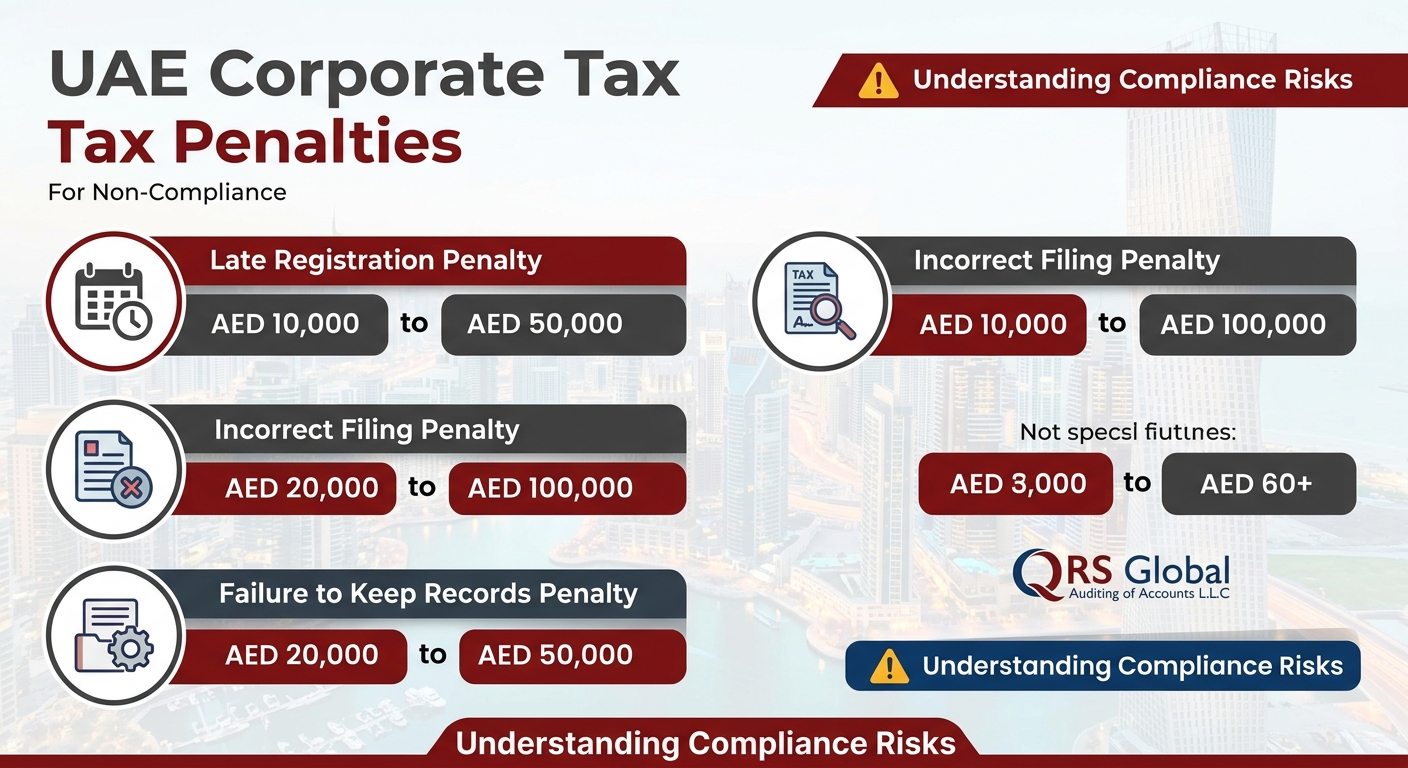
Corporate Tax Penalty UAE
Understanding the corporate tax penalty UAE rules is essential for businesses that want to maintain proper compliance.
Depending on the specific circumstances, administrative penalties can arise from different types of non-compliance, including certain failures relating to registration, filing, payment, record keeping, or providing required information.
The applicable penalty depends on the nature of the violation and the current UAE tax regulations.
Businesses should therefore focus on maintaining accurate records and monitoring deadlines rather than waiting until a compliance issue occurs.
How Can Businesses Reduce Corporate Tax Compliance Risks?
Businesses can reduce avoidable risks by:
Keeping accounting records updated
Monitoring FTA deadlines
Maintaining supporting documentation
Reviewing tax obligations regularly
Reconciling financial records
Preparing tax information before filing deadlines
Obtaining professional advice when the tax position is complex
Corporate Tax for Free Zone Companies
Free zone companies should carefully evaluate their Corporate Tax position.
A free zone company is not automatically outside the UAE Corporate Tax framework. Depending on the applicable requirements and conditions, a qualifying free zone person may receive specific treatment for qualifying income.
This makes accurate accounting and proper classification of income particularly important.
Free zone businesses should maintain clear records relating to:
Business activities
Revenue sources
Customers
Expenses
Qualifying and non-qualifying income where relevant
Related-party transactions
Supporting documents
Where the tax treatment depends on detailed conditions, professional tax advice can help businesses understand their position.
Corporate Tax for Startups
Startups should consider Corporate Tax compliance from the early stages of business development.
Waiting until a company becomes large can create unnecessary accounting and compliance problems.
A startup should establish good financial practices from the beginning, including:
Proper bookkeeping
Separate business and personal finances
Organized invoices and receipts
Accurate expense records
Bank reconciliation
Revenue monitoring
Financial reporting
Tax registration assessment
Compliance deadline tracking
Strong financial systems can also help founders understand profitability, manage cash flow, and make better business decisions.
VAT and Corporate Tax in UAE
VAT and Corporate Tax are separate tax systems with different rules and purposes.
VAT generally relates to taxable supplies of goods and services when the applicable conditions are met. Corporate Tax, on the other hand, generally applies to taxable income under the UAE Corporate Tax framework.
A business may therefore have obligations under both systems.
Proper accounting records can help businesses manage:
VAT transactions
Corporate Tax calculations
Revenue
Business expenses
Tax invoices
Financial statements
Supporting documentation
Businesses should evaluate their VAT and Corporate Tax responsibilities separately while maintaining an accounting system that supports both.
Corporate Tax Consultants in Dubai
Businesses operating in Dubai may seek professional assistance from corporate tax consultants in Dubai for tax registration, eligibility assessments, accounting coordination, compliance reviews, and tax filing support.
Professional assistance can be particularly valuable for:
New businesses
SMEs
Free zone companies
Companies with international transactions
Businesses with multiple activities
Companies preparing their first tax return
Businesses unsure about their compliance obligations
The right adviser should first understand the company’s business model and financial circumstances before recommending a compliance approach.
Corporate Tax Consultants in UAE
Companies operating in different Emirates can also work with corporate tax consultants in UAE for broader tax and accounting support.
Professional tax support may include:
Corporate Tax registration
Tax assessment
Tax calculations
Tax return preparation
Filing support
Accounting and bookkeeping
Financial reporting
Compliance reviews
Record-keeping guidance
Tax advisory
Combining accounting and tax expertise can make it easier for businesses to maintain accurate financial information and meet their ongoing obligations.
Corporate Tax Consultant Dubai: What Services Can You Expect?
A Corporate Tax Consultant Dubai can assist businesses at different stages of their tax compliance cycle.
Depending on the service provider, support may include:
Tax registration assistance
Corporate Tax eligibility assessment
Tax return preparation
Tax calculations
Accounting and bookkeeping
Financial reporting
Compliance reviews
FTA correspondence support
Record-keeping guidance
Tax planning and advisory
The level of professional support required depends on the company’s size, industry, legal structure, financial activity, and tax complexity.
Common Corporate Tax Registration Mistakes
Businesses can reduce compliance risks by avoiding several common mistakes.
Providing Incorrect Company Information
Information submitted during registration should match official company documents and current business records.
Ignoring the Applicable Registration Deadline
Businesses should identify the deadline that applies specifically to their entity rather than relying on a generic date.
Assuming Free Zone Status Means No Corporate Tax
Free zone companies should assess their position according to the applicable rules and conditions.
Maintaining Poor Accounting Records
Incomplete or inaccurate bookkeeping can make taxable-income calculations more difficult and increase the possibility of errors.
Waiting Until the Filing Deadline
Tax compliance should be managed throughout the year. Preparing financial information at the last minute can make the process more difficult and increase the risk of mistakes.
Why Accurate Accounting Matters for Corporate Tax
Corporate Tax compliance depends heavily on reliable financial information.
A business should maintain accurate records of:
Sales
Purchases
Operating expenses
Payroll
Bank transactions
Assets
Liabilities
Receivables
Payables
Other relevant financial transactions
Regular bookkeeping allows businesses to identify discrepancies early and provides a stronger basis for calculating taxable income.
This is why accounting, financial reporting, and tax compliance should be treated as connected business functions rather than completely separate activities.
Why Choose QRS Global Auditing of Accounts L.L.C?
Choosing an experienced professional firm can help businesses approach tax compliance with greater confidence.
QRS Global Auditing of Accounts L.L.C provides accounting, auditing, taxation, and financial compliance services for businesses in the UAE.
The firm’s services are designed to support businesses with practical financial and tax requirements, including:
Corporate Tax registration assistance
Corporate Tax compliance
Accounting and bookkeeping
Financial reporting
Tax calculations
VAT support
Audit services
Financial record reviews
Tax and accounting advisory
A Trusted UAE Accounting and Audit Firm
QRS Global Auditing of Accounts L.L.C has built its services around accounting, auditing, tax, and financial support for UAE businesses.
The company website, qrsaudit.com, provides information about its professional services and areas of expertise.
For businesses evaluating a professional adviser, relevant trust factors include the firm’s experience, professional team, service expertise, client experience, and ability to provide ongoing support rather than one-time assistance.
Need Professional Corporate Tax Support?
If your business needs assistance with registration, accounting, tax compliance, or financial reporting, you can contact QRS Global Auditing of Accounts L.L.C for professional guidance.
Get Corporate Tax Assistance →
Visit QRS Global Auditing of Accounts L.L.C →
Frequently Asked Questions
What is Corporate Tax Registration in UAE?
Corporate Tax registration is the process through which a taxable person registers with the Federal Tax Authority under the UAE Corporate Tax framework and obtains the relevant tax registration details.
Is Corporate Tax registration the same as paying Corporate Tax?
No. Registration, filing, and payment are separate compliance responsibilities. A company may have a registration or filing requirement while its final taxable income determines whether tax is payable.
What is the UAE Corporate Tax rate?
The UAE Corporate Tax framework generally applies a 0% rate to taxable income up to AED 375,000 and a 9% rate to taxable income exceeding AED 375,000, subject to applicable rules.
Do free zone companies need to register?
Free zone businesses should assess their registration and tax obligations individually. Being established in a free zone does not automatically remove a company from the UAE Corporate Tax framework.
What happens if a business misses a Corporate Tax obligation?
Depending on the specific non-compliance, administrative penalties or other consequences may apply. Businesses should address missed obligations promptly and obtain professional advice where necessary.
Can a tax consultant help with Corporate Tax registration?
Yes. A qualified tax professional can assist with eligibility assessment, documentation, registration procedures, tax calculations, filing, and ongoing compliance support.
When should a startup consider Corporate Tax compliance?
A startup should assess its tax obligations early and establish proper bookkeeping and financial reporting systems from the beginning.
Final Thoughts
Understanding Corporate Tax Registration in UAE is important for businesses that fall within the UAE Corporate Tax framework. However, registration should not be viewed as the end of the compliance process.
Businesses also need accurate accounting records, proper documentation, timely filing, correct taxable-income calculations, and effective monitoring of applicable deadlines.
Companies operating in free zones, startups, SMEs, and businesses with international activities should pay particular attention to their individual tax position.
With the right financial systems and professional guidance, businesses can manage their Corporate Tax responsibilities more efficiently while maintaining accurate and organized financial records.
QRS Global Auditing of Accounts L.L.C can assist UAE businesses with accounting, auditing, tax, and financial compliance requirements.
Need help with your Corporate Tax requirements? Contact QRS Global Auditing of Accounts L.L.C for professional support.
Important: UAE tax legislation, deadlines, administrative penalties, and FTA procedures may change. Businesses should verify the latest requirements with the Federal Tax Authority or obtain advice from a qualified UAE tax professional before making tax or compliance decisions.