Corporate Tax Groups in the UAE: Eligibility, Formation and Key Rules
A working guide to the FTA’s revised Corporate Tax Guide on Tax Groups (CTGTGR1, November 2026), with QRS observations from audit and advisory practice.
In November 2026 the Federal Tax Authority (FTA) re-issued its Corporate Tax Guide on Tax Groups (CTGTGR1), revising the January 2024 first edition. The 171-page guide explains who may form a Tax Group, how the group is administered and how its Taxable Income, Tax Losses, interest capacity and foreign tax attributes are determined. This article condenses that guidance for boards, finance teams and tax practitioners. Prepared by the Technical Advisory Department, QRS Global Auditing of Accounts L.L.C. Position as at 14 November 2026.
Unless stated otherwise, “Article” refers to Federal Decree-Law No. 47 of 2022 on the Taxation of Corporations and Businesses, as amended (the Corporate Tax Law), and “MD 301” to Ministerial Decision No. 301 of 2024, which governs Tax Periods commencing on or after 1 January 2025. Earlier Tax Periods remain subject to Ministerial Decision No. 125 of 2023.
Corporate Tax Groups at a Glance
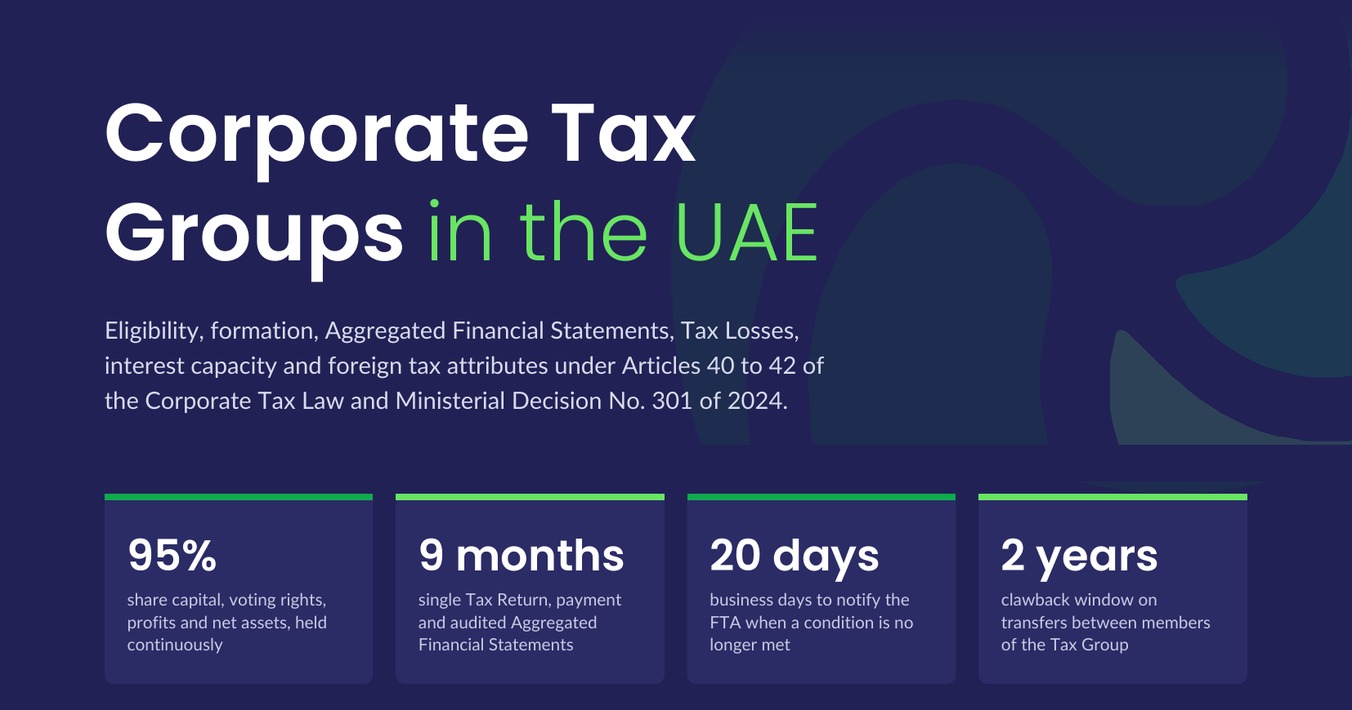
- 95%: share capital, voting rights, and profits and net assets, held continuously
- 9 months: single Tax Return, payment and audited Aggregated Financial Statements
- 20 business days: to notify the FTA when a condition is no longer met
- 2 years: clawback window on transfers between members of the Tax Group
| Instrument | Relevance to Tax Groups |
|---|---|
| Corporate Tax Law, Articles 40 to 42 | Conditions, formation, membership changes and Taxable Income of a Tax Group |
| Ministerial Decision No. 301 of 2024 | Detailed Tax Group rules (replaced Ministerial Decision No. 125 of 2023 from 1 January 2025) |
| FTA Decision No. 7 of 2025 | Special purpose framework for audited Aggregated Financial Statements |
| Ministerial Decision No. 84 of 2025 | Every Tax Group must prepare and maintain audited special purpose financial statements |
| Ministerial Decision No. 302 of 2024 | Participation Exemption, Foreign Permanent Establishment exemption and liquidation losses |
| Ministerial Decision No. 126 of 2023 | General Interest Deduction Limitation Rule, including pre-Grouping Net Interest Expenditure |
| Ministerial Decision No. 173 of 2025 | Tax depreciation on Investment Property held at fair value |
| Ministerial Decision No. 73 of 2023, as amended | Small Business Relief, tested on the group’s aggregated Revenue (amended by Ministerial Decision No. 131 of 2026) |
| FTA Decisions No. 5, 6, 12 and 13 of 2023 | Change of Tax Period; deregistration timeline; Subsidiaries of Government Entities; currency conversion |
| Cabinet Decision No. 63 of 2025 | Unincorporated Partnerships approved as Taxable Persons in their own right |
What the November 2026 Edition Updates
- Unincorporated Partnerships approved as Taxable Persons (Cabinet Decision No. 63 of 2025).
- Aggregated Financial Statements and their audit (Ministerial Decision No. 84 of 2025; FTA Decision No. 7 of 2025).
- Depreciation on fair-valued Investment Property (Ministerial Decision No. 173 of 2025).
- Liquidation losses on Participations, and loss recapture on Foreign Permanent Establishments.
- Use and forfeiture of pre-Grouping Tax Losses and Net Interest Expenditure, and group-level Foreign Tax Credit.
Verified on Official Sources (Checked 14 November 2026)
- Ministerial Decision No. 84 of 2025, Article 2(2) (tax.gov.ae): a Tax Group must prepare and maintain audited special purpose financial statements. Unlike a standalone Taxable Person, no AED 50 million Revenue threshold applies.
- Ministerial Decision No. 131 of 2026 (mof.gov.ae, issued 29 July 2026): the Small Business Relief threshold continues for Tax Periods ending on or before 31 December 2029.
- FTA Decision No. 12 of 2026 concerns Top-up Tax registration only; the 3-month Corporate Tax deregistration timeline in FTA Decision No. 6 of 2023 is unchanged.
1. What Is a Corporate Tax Group?
A Tax Group is two or more juridical Resident Persons that, on a joint application approved by the FTA, are treated as a single Taxable Person (Article 40(4)). The Parent Company files one Tax Return for the group (Article 53(7)), the results of all members are aggregated, and transactions between members are generally eliminated. There is no limit on the number of members and no requirement for their Businesses to be related, but a juridical person can belong to only one Tax Group at a time, and a Parent Company cannot form more than one Tax Group.
| Advantages | Trade-offs to weigh |
|---|---|
| One Tax Return, one payment and one Tax Registration Number for the group | Every member is jointly and severally liable for the group’s Corporate Tax |
| Profits and losses of members offset automatically through aggregation | Audited special purpose Aggregated Financial Statements are mandatory for every Tax Group |
| Intra-group transactions, asset transfers and dividends generally eliminated, so no arm’s length adjustment on eliminated items | One AED 375,000 0% band for the whole group; Small Business Relief tested on aggregated Revenue |
| Interest capacity (30% of tax-adjusted EBITDA) measured on combined group EBITDA | Clawback if a transferor or transferee leaves within 2 years of an intra-group transfer |
| Deductibility of expenditure judged against the Business of the whole group | Pre-Grouping losses usable only against income attributable to that member; group elections bind members after they leave |
Foreign-owned structures: a non-resident company cannot be a member, but its UAE Subsidiaries can group under a UAE Parent Company. Sister UAE sub-holdings without a common UAE parent form separate groups (FTA Example 1).

QRS insight: A Tax Group usually pays off where members have uneven profitability, material intra-group trading or financing, or regular asset transfers. Where every member is profitable and intra-group dealings are minor, weigh the cost of aggregation, a mandatory special purpose audit and joint liability against the filing saving. Qualifying Group Relief and Tax Loss transfers under Articles 26 and 38 may achieve part of the benefit without grouping.
2. Eligibility Conditions (Article 40(1))
All conditions must be met by the Parent Company and every Subsidiary.
| # | Condition | Requirement | Reference |
|---|---|---|---|
| 1 | Juridical person | Separate legal personality (companies, incorporated partnerships). Natural persons and Unincorporated Partnerships are excluded, unless the partnership is approved under Article 16(8), which deems it a juridical Resident Person. | Art 40(1)(a); CD 63/2025 |
| 2 | Resident Person | Incorporated in the UAE, or foreign-incorporated but effectively managed and controlled in the UAE, and not tax resident elsewhere under a Double Taxation Agreement in force. | Art 11(3); MD 301 Art 3 |
| 3 | Share capital | Parent owns at least 95% of the nominal issued and paid-up capital (legal title), directly or through Subsidiaries. | Art 40(1)(b) |
| 4 | Voting rights | Parent holds at least 95% of the voting rights on shareholder matters, directly or through Subsidiaries. | Art 40(1)(c) |
| 5 | Profits and net assets | Parent is entitled to at least 95% of profits and at least 95% of net assets, directly or through Subsidiaries. | Art 40(1)(d) |
| 6 | Not an Exempt Person | No member may be an Exempt Person. Taxable Subsidiaries of a Government Entity may group without it under FTA Decision No. 12 of 2023. | Art 40(1)(e), 40(2) |
| 7 | Not a QFZP | No member may be a Qualifying Free Zone Person, unless it has elected under Article 19 to be taxed at the standard rates. | Art 40(1)(f) |
| 8 | Same Financial Year | All members share the same Financial Year and therefore the same Tax Period. | Art 40(1)(g) |
| 9 | Same Accounting Standards | All members use IFRS, or all use IFRS for SMEs (available where Revenue does not exceed AED 50 million). | Art 40(1)(h) |
Continuous compliance: the conditions must be met continuously throughout the Tax Period (MD 301 Art 2(1)). A Subsidiary that fails at any point is treated as leaving from the beginning of that Tax Period; if the Parent fails, the group ceases from the beginning of that period unless the Parent is replaced under Article 40(12). Exceptions: a newly established entity can join from its date of incorporation, and a member that ceases to exist by transferring its entire Business to another member remains a member until that date.
The Three 95% Ownership Tests
The share capital, voting rights and profits and net assets tests are separate. Each counts indirect holdings only through Subsidiaries that themselves meet every condition and are in the group, and indirect holdings are counted proportionately. A chain cannot be “interrupted”: if an intermediate entity fails, or qualifies but opts out, entities held through it cannot join.

| Test | How it is measured |
|---|---|
| Share capital |
|
| Voting rights |
|
| Profits and net assets |
|
Share Transactions
- Within the group: no effect, provided the Parent keeps at least 95% directly or indirectly throughout the period.
- Sale outside the group: the Subsidiary, and entities held through it, leave from the start of the Tax Period of sale. The buyer cannot group the target for that period, unless a newly incorporated acquirer replaces a Parent or a universal legal successor takes over.
- Signing versus closing: share capital follows legal title, which stays with the seller until transfer. Entitlement to profits and net assets passes when the share purchase agreement becomes unconditional, so the profits test can fail before title moves.
- Temporary dips count: T transferred 10% of U to a third party from 1 to 8 October 2025. U leaves from 1 January 2025, and the FTA must be notified within 20 business days of 1 October 2025 (FTA Example 12).
Residence, Free Zones and Exempt Persons
| Dual-resident entity | Outcome |
|---|---|
| DTA tie-breaker allocates residence to the UAE | Eligible |
| DTA tie-breaker allocates residence to the other state | Not eligible. An existing member leaves from the start of the Tax Period in which it becomes foreign resident. |
| DTA resolves residence by mutual agreement, not yet concluded | Not eligible until the competent authorities allocate residence to the UAE |
| No DTA in force with the other jurisdiction | Eligible; dual residence under foreign domestic law alone is not a bar |
- A Free Zone Person that is not a QFZP can be a Parent or a Subsidiary.
- A QFZP that elects under Article 19 can form or join from the Tax Period in which the election takes effect.
- A Free Zone branch of a non-resident cannot join: it has no separate legal personality.
- A member that becomes an Exempt Person or a QFZP leaves from the start of that period. If the Parent does, the group ceases unless the Parent is replaced.
Financial Year and Accounting Standards
- If the Parent changes its Financial Year, every member must change with it; members left misaligned leave from the start of that Tax Period.
- A newly incorporated entity can join from incorporation if its first year end aligns with the group’s. Its first Financial Year may run 6 to 18 months under the Commercial Companies Law.
- To align year ends, the FTA may approve a change of Tax Period of not less than 6 or more than 18 months (FTA Decision No. 5 of 2023). For example, P (31 December year end) buys Q (31 August) on 3 May 2024: either Q moves to a December year end (group from 1 January 2025), or P moves to August (group from 1 September 2025).
- Mixed IFRS and IFRS for SMEs fails condition 9. Accounting policies may differ in standalone statements, but must be made uniform for aggregation (FTA Decision No. 7 of 2025, Art 3(4)(e)).
Eligibility Decision Path
- Juridical persons? Natural persons and ordinary Unincorporated Partnerships cannot join. A partnership may apply under Article 16(8) to be a Taxable Person in its own right.
- UAE resident only? Each entity must be a UAE Resident Person and not treaty-resident in another state. Otherwise review effective management and the DTA tie-breaker or mutual agreement outcome.
- Taxable at standard rates? Exempt Persons and QFZPs are excluded. A QFZP may elect under Article 19; Government Entity Subsidiaries follow FTA Decision No. 12 of 2023.
- 95% throughout the period? If not, the entity cannot join for that period. Restructure holdings or the chain; 75% reliefs (Articles 26 and 38) may still apply.
- Same Financial Year? If not, apply to change the Tax Period to align year ends (6 to 18 months; FTA Decision No. 5 of 2023).
- Same Accounting Standards? If not, move every member onto the same standards before the first grouped Tax Period.
If every step is answered “yes”, the group is eligible: file the joint EmaraTax application before the end of the first intended Tax Period, then plan the Aggregated Financial Statements and the special purpose audit.
3. Formation, Administration and Liability
The Parent Company and each Subsidiary apply jointly through EmaraTax, stating the first intended Tax Period, before the end of that Tax Period (MD 301 Art 5(1)). The FTA may set a different starting period (Article 41(1)). Approval is not an ongoing confirmation: the FTA may reassess at any time, and if the conditions fail during the first Tax Period, the group or the member is treated as never having been formed for that period. Each applicant needs its own Corporate Tax registration number. The group then receives a separate one, and members are not deregistered.
| Parent Company obligation | Timing | Reference |
|---|---|---|
| File the group Tax Return | Within 9 months of the Tax Period end | Art 53(1), 53(7) |
| Pay the Corporate Tax Payable | Within 9 months of the Tax Period end | Art 40(5), 48 |
| Prepare and submit audited Aggregated Financial Statements | Within 9 months of the Tax Period end | FTA Dec. 7/2025 Art 2(3); MD 84/2025 Art 2(2) |
| Notify the FTA when a condition is no longer met | Within 20 business days | MD 301 Art 12 |
| Register and deregister the group; claim refunds | As required | Art 40(5), 49, 51, 52 |
| Keep records and transfer pricing documentation; handle clarifications | Ongoing | Art 40(5), 54 to 56 |
Joint and several liability: all members are jointly and severally liable for the group’s Corporate Tax for the periods of their membership, and this survives leaving (Article 40(6)). The group may apply to limit liability to named members; the FTA decides case by case (Article 40(7)). Administrative Penalties for the group’s compliance failures fall on the Parent alone.
Watch-out, mistaken membership: if an ineligible entity was included in the group return, the return must be corrected. Penalties fall on the Parent, and any tax shortfall falls on the remaining members. The excluded entity may also face penalties for not filing its own standalone return. Re-test eligibility before every filing.
4. Changes in Membership and Cessation
| Event | Application or notice | Effective from |
|---|---|---|
| Form a Tax Group | Joint application before the end of the Tax Period requested | Start of that Tax Period, or as the FTA determines |
| Subsidiary joins | Joint application before the end of the Tax Period requested | Start of that Tax Period, or as the FTA determines |
| Newly incorporated Subsidiary or new Parent | Joint application; conditions met from incorporation and year end aligned | Date of incorporation |
| Subsidiary leaves voluntarily | Application before the end of the Tax Period | Start of the Tax Period specified |
| Subsidiary stops meeting a condition | Notify within 20 business days | Start of the Tax Period in which it fails |
| Member becomes treaty-resident abroad | Notify within 20 business days | Start of that Tax Period |
| Member transfers its entire Business to another member and ceases | Notify within 20 business days | Date it ceases to exist |
| Parent replaced (Art 40(12)) | Application before the end of the relevant Tax Period; may be filed while a merger is being prepared | Start of the Tax Period; date of transfer if the Parent merges into a member |
| Cessation on the Parent’s application | Application before the end of the Tax Period; also treated as the deregistration request | Start of the Tax Period specified |
| Parent stops meeting a condition and is not replaced | Notify within 20 business days; treated as the deregistration request | Start of that Tax Period |
| Two-member group: one transfers its Business to the other and ceases | Surviving entity notifies within 20 business days | Date the transfer is effective; two returns for that period |
The FTA may also dissolve a group or change its Parent on its own initiative, based on information available to it (Article 40(13)).
Replacing the Parent Without Ending the Group
- The new Parent meets Article 40(1) in relation to the former Parent, from the start of the Tax Period, or from incorporation if newly formed. For example, a QFZP holding company elects under Article 19 and becomes the Parent from the start of that period.
- Alternatively, the former Parent ceases and the new Parent or a Subsidiary is its universal legal successor, for instance on a merger. A successor from outside the group qualifies if newly established, or if the transfer takes effect at the start of the Tax Period.
Consequences for a Member That Leaves, or When the Group Ceases
- The member files a standalone Tax Return for the whole Tax Period in which it leaves, under its own registration number. It does not deregister unless it ceases to exist; it must then apply within 3 months of ceasing (FTA Decision No. 6 of 2023).
- It remains jointly liable for the group’s tax for its membership periods, unless liability was limited.
- If the group continues, its Tax Losses and carried-forward Net Interest Expenditure stay with it and the leaver takes only its own unused pre-Grouping amounts. If the group ceases, they pass to the Parent.
- It adopts the values in the Aggregated Financial Statements as opening values (MD 301 Art 13). For example, an asset carried at AED 100 by the group but AED 120 in the member’s own books has a tax base of AED 100, unless a clawback applies.
- It keeps the group’s accounting basis and elections: realisation basis, Qualifying Group Relief, transitional rules and Investment Property depreciation.
Worked illustration, Parent merges into a Subsidiary: C (Parent) and D form a group. C merges into D on 1 March 2026 and D is its universal successor. The group ceases on 1 March 2026. As successor, D files the group’s final return for 1 January to 28 February 2026 by 30 November 2026, and its own standalone return for the period to 31 December 2026 (FTA Example 15).
5. Aggregated Financial Statements and the Special Purpose Audit
Taxable Income starts from Aggregated Financial Statements: the standalone IFRS (or IFRS for SMEs) statements of the members, aggregated line by line, with transactions between members eliminated (Article 42(1)). This is a special purpose framework under FTA Decision No. 7 of 2025. It departs from IFRS consolidation in specific respects, so it may differ from any consolidated statements the group already prepares.
| Area | Aggregated Financial Statements | IFRS consolidated statements |
|---|---|---|
| Entities | Tax Group members only. Other subsidiaries, joint ventures and associates are carried at cost less impairment. | All controlled entities; equity method for associates and joint ventures |
| Acquisitions of legal entities | No IFRS 3 or IFRS 10 adjustments: no goodwill, bargain purchase gain or fair value uplift | Recognised |
| Business acquired without a legal entity | Included as recorded in the acquirer’s separate statements, including goodwill | Recognised |
| Investment in members vs their equity | Not eliminated, so the balance sheet grosses up; impairment of these investments is also not eliminated | Eliminated |
| Other intra-group items | Balances, income, expenses, unrealised gains and losses, valuation adjustments and provisions eliminated | Eliminated |
| Dealings with non-member group entities | Not eliminated | Eliminated if in scope |
| Taxes | Profit aggregated before UAE Corporate Tax; Corporate Tax balances not aggregated. Foreign and Emirate-level taxes are still shown. | Current and deferred tax included |
| Currency and policies | AED (FTA Decision No. 13 of 2023); uniform accounting policies | Presentation currency; uniform policies |
| Primary statements | Financial position, profit or loss, OCI and changes in equity; no cash flow statement. Comparatives required except in the group’s first Tax Period. | Full set, including cash flows |
| Disclosures | Framework; members with % of capital, votes and profits or net assets held; material policies, estimates and judgements; notes consistent with IAS 1 | Full IFRS |
Worked Illustration: Balance Sheet Aggregation
| AED million | J (Parent) | K | Aggregated |
|---|---|---|---|
| Cash and inventories | – | 5 | 5 |
| Loan receivable from K | 10 | – | 0 (eliminated) |
| Investment in K | 5 | – | 5 (kept) |
| Property, plant and equipment | – | 20 | 20 |
| Total assets | 15 | 25 | 30 |
| Trade payables | – | 10 | 10 |
| Loan payable to J | – | 10 | 0 (eliminated) |
| Total liabilities | 0 | 20 | 10 |
| Equity | 15 | 5 | 20 |
The investment in K and K’s equity are both kept, so equity aggregates to 20. If J later impairs the loan, the loss is eliminated with the loan (FTA Examples 17 and 18).
Exception to elimination (MD 301 Art 4): if a member deducted a loss on a transaction with another member before forming or joining the group (an impaired intra-group loan, interest later waived, or a foreign exchange loss), the transaction is not eliminated until that deduction has been reversed in full. Reversal income is taxed up to the amount previously deducted. Further impairments after grouping are eliminated and give no additional deduction. Income that is not a reversal, such as interest received, is outside the exception.
The Special Purpose Audit
- Every Tax Group must prepare and maintain audited special purpose financial statements (MD 84/2025 Art 2(2)). There is no Revenue threshold, unlike the AED 50 million test for standalone Taxable Persons.
- The audited statements are submitted within 9 months of the Tax Period end (FTA Decision No. 7 of 2025, Art 2(3)).
- The Corporate Tax Law does not require members’ standalone statements to be audited, although company law or licensing authorities may.
- The FTA illustrative report (Appendix A) provides for an audit under ISAs and an opinion that the statements are prepared, in all material respects, in accordance with the accounting policies in the notes. It includes an Emphasis of Matter on the basis of accounting and the restriction on distribution and use (Tax Group and FTA only). There are no Key Audit Matters, no Other Information section and no report on other legal and regulatory requirements.
- Mandatory basis-of-preparation wording covers the purpose of the statements, any separate IFRS consolidated statements, a members table (name, country, registration date, ownership), non-members at historical cost and excluded IFRS 3 and IFRS 10 adjustments.
QRS insight, audit approach: the FTA’s illustrative report reflects the features of an audit of special purpose financial statements under ISA 800 (Revised). Plan to re-perform the three 95% tests for the full period; confirm aligned year ends, framework and uniform policies; reconcile intra-group balances to nil; test completeness of eliminations, including unrealised profit in inventory and fixed assets; confirm that investments, member equity and investment impairments were not eliminated; track pre-grouping loss exceptions; and check AED translation and comparatives.
6. Intra-Group Transfers and the 2-Year Clawback
Article 42(9) and (10); MD 301 Articles 10 and 11.
Transfers of assets and liabilities between members are eliminated. If the transferor or transferee leaves the group within 2 years of the transfer, the gain or loss not yet taken into account is brought in on the date of leaving, measured by reference to Market Value at the date of the transfer. The group, or the former member, then adjusts the tax cost base. If the group ceases on the same day, the amount goes in the group’s final return.
No clawback applies where the income would have been exempt or disregarded anyway: for example under the Participation Exemption, or where the transfer would have qualified for Qualifying Group Relief or Business Restructuring Relief, without a clawback, had the parties not been grouped. No election is needed for this exception. The same test applies when a member transfers its entire Business to another member and ceases to exist, such as on a legal merger.
Worked Illustration: Clawback Timeline (FTA Example 20)
| Date | Transfer of asset 1 (AED million) | Book value | Market value |
|---|---|---|---|
| 31 Mar 2024 | T to U, for cash | 1.0 | 1.2 |
| 31 Mar 2025 | U to W, for cash | 1.0 | 1.4 |
| 1 Feb 2027 | T sells its shares in U to a third party | – | – |
- U leaves from 1 January 2027, the start of the Tax Period of sale.
- The 2024 transfer is more than 2 years earlier, so there is no clawback.
- The 2025 transfer is within 2 years. Qualifying Group Relief would have been clawed back and Business Restructuring Relief was unavailable, so the gain of AED 0.4m (1.4 less 1.0) is taxed in the 2027 return.
- The tax cost base of asset 1 becomes AED 1.4m.
Investment Property: where a clawback applies to an intra-group transfer, the transferee (or the group) can also claim the tax depreciation it was previously denied (MD 173/2025 Art 2(3)).
7. Corporate Tax Provisions Applied at Group Level
Under Article 42(2), the group is treated as one Taxable Person unless the law provides otherwise.
| Provision | Treatment for a Tax Group | Reference |
|---|---|---|
| 0% band | The AED 375,000 band taxed at 0% applies once to the group’s Taxable Income, however many members there are. | Art 3(1)(a); CD 116/2022 |
| Small Business Relief | Tested on the group’s aggregated Revenue: AED 3 million or less in the current and all previous Tax Periods, and no member may be a Constituent Company of an MNE group required to file a Country-by-Country Report. A member loses standalone relief on joining. Available for Tax Periods ending on or before 31 December 2029. | Art 21; MD 73/2023; MD 131/2026 |
| Participation Exemption | The 5% ownership and AED 4 million acquisition-cost thresholds combine holdings of all members and of entities in the same Qualifying Group as any member. | Art 23; MD 302/2024 Art 3, 8 |
| Qualifying Group Relief and loss transfers | The 75% ownership tests aggregate members’ holdings. A group election also covers transfers with non-members. Forming or joining a group with an electing member is a deemed election, and the election follows members who leave. Leaving within 2 years of a relieved transfer can trigger clawback. | Art 26, 38; MD 301 Art 9, 13 |
| Loss carry-forward continuity | The 50% ownership test looks to ownership of the Parent; membership changes alone do not breach it. Business continuity is judged on the group’s Business as a whole. For pre-Grouping losses, both tests apply to the relevant Subsidiary. | Art 39 |
| Realisation basis | One election by the group in its first Tax Period, applied to the Aggregated Financial Statements. Joining members follow the group’s choice, and former members stay bound. If a Bank or Insurance Provider is a member, the election is limited to capital-account items; its joining may justify amending an existing election, prospectively and with FTA approval. | Art 20(3); MD 134/2023 Art 2, 8 |
| Investment Property depreciation | Optional deduction for fair-valued property, from Tax Periods starting 1 January 2025: the lower of 4% of Original Cost and Tax Written Down Value. The group elects in the return for its first Tax Period from 2025 in which members hold such property (or its first period without Small Business Relief); otherwise the right is forfeited. Intra-group transfers keep the Original Cost; a joining Subsidiary computes an Opening Value; deductions are recaptured on realisation. | MD 173/2025 |
| Deductibility | “Wholly and exclusively” is assessed against the Business of the whole group. Costs borne for another member can be deductible; costs incurred for a non-member, such as a foreign parent, are not. | Art 28(1) |
| Transitional rules | Where the group was formed for its first Tax Period, the opening balance sheet aggregates members’ closing balance sheets and ownership periods are combined. A group formed later cannot newly elect if members did not elect in their first period; members’ elections carry into the group. | Art 61; MD 120/2023 Art 5 |
| Minority shareholders | All of a Subsidiary’s income is included even if up to 5% is held outside the group. Dividends between members are eliminated. A partial sale that keeps the 95% tests intact may qualify for the Participation Exemption. | Art 42 |
| Liquidation loss on a Participation | Deductible, while liquidation gains are exempt. The loss is reduced by items in the current and preceding seven Tax Periods: losses transferred from the Participation, exempt dividends received by any member (including before joining), and below-Market-Value transfers. For a former member, it is also reduced by its pre-Grouping losses used by the group and dividends eliminated in the group. No loss arises where the member ceased by transferring its whole Business to another member. | Art 23(8); MD 302/2024 Art 13 |
Worked illustration, liquidation loss: J acquires a 25% Participation in L for AED 4.0m and transfers it to K, a member, for AED 3.2m. The transfer is eliminated, so the cost stays AED 4.0m. Exempt dividends from L total AED 1.5m (0.5m to J, then 0.6m and 0.4m to K). The group ceases, and L is liquidated with proceeds of AED 2.2m. K’s loss of AED 1.8m is reduced by all AED 1.5m of dividends, wherever received, to a deductible AED 0.3m (FTA Example 27).
8. Attribution of Taxable Income (MD 301 Article 8)
The group must calculate the Taxable Income attributable to particular members when: (i) it uses a member’s pre-Grouping Tax Losses; (ii) a new member joins while the group has unutilised Tax Losses; (iii) a member benefits from incentives under Article 20(2)(g); or (iv) it uses a member’s pre-Grouping Net Interest Expenditure (NIE). For Tax Periods before 1 January 2025, attribution was also needed for Foreign Tax Credits.
How the Attribution Is Built
- Start from the member’s standalone Accounting Income.
- Apply the same aggregation adjustments as the group: remove intra-group items and IFRS 3 or IFRS 10 effects, align depreciation with group carrying values, and keep investment impairments.
- Apply the arm’s length principle where relevant: on a later realisation of a previously eliminated transfer, for Foreign Permanent Establishment profits and for incentives.
- Make the Article 20(2) adjustments and allocate the member’s share of deductible NIE (Section 10).
Points to Note
- The attributions should add up to the group’s Taxable Income before loss relief.
- When an asset moved between members is later sold outside the group, the deferred intra-group gain is attributed to the original transferor, and only the remainder to the seller (FTA Example 29).
- The group must disclose the member’s transactions with other members and with Related Parties to the FTA (Article 55(1)).
9. Tax Losses in a Tax Group
Articles 37 to 39 and 42(3) to 42(8); MD 301 Articles 7 and 8.
A Tax Loss computed on the aggregated results is a loss of the group, not of any member. Carried-forward losses can offset up to 75% of the group’s Taxable Income, and that cap applies at group level only. Losses are used in this order:
- Pre-Grouping Tax Losses: optional, but used first. Cap per member: the lower of its attributable Taxable Income and 75% of group Taxable Income. The Parent chooses the order between members.
- Tax Group losses: includes restricted losses, which cannot shelter income attributable to Subsidiaries that joined after the loss arose. Cap: 75% × (group income − new members’ income).
- Losses transferred in: Tax Losses received from another Taxable Person under Article 38 are used last, within the remaining 75% capacity.
Worked illustration, pre-Grouping cap: group Taxable Income is AED 0.8m; the income attributable to J is AED 1.2m; J’s pre-Grouping loss is AED 1.0m. Usable: the lower of 75% × 0.8 = 0.6m and 1.2m. Carried forward: 0.4m (FTA Example 36).
Worked illustration, restricted group losses: the group has AED 50m of 2024 losses. G joins in 2025. Group income is AED 100m, of which AED 60m is attributable to G after eliminations. Usable: 75% × (100 − 60) = AED 30m. Carried forward: AED 20m (FTA Example 35).
Watch-out, forfeiture: if the group had capacity to use a member’s pre-Grouping losses but did not attribute income to that member, and used less than it could have, those losses are forfeited in full (MD 301 Art 8(4)). They are not forfeited where the member’s attributable result was a loss, or where the group can show it would have been. Once the group opts to use them, they must be used to the fullest extent possible.
Where Losses Go When Membership Changes
| Event | Effect on Tax Losses |
|---|---|
| Subsidiary joins | Its unutilised losses become pre-Grouping losses, usable only against income attributable to it |
| Subsidiary leaves | Group losses stay with the group, even if economically linked to the leaver; its own unused pre-Grouping losses go with it |
| Group ceases | Group losses and the Parent’s pre-Grouping losses pass to the Parent. They are forfeited if the Parent ceases or stops being a Taxable Person, unless it is replaced under Article 40(12). |
| Member transfers its Business within the group and ceases | Its pre-Grouping losses are lost unless the transfer would have met the Business Restructuring Relief conditions outside a group; no election is needed |
| Loss transfer to or from another group (Art 38) | 75% common ownership is tested through the Parent’s holdings, with the same Parent throughout. Replacing the Parent mid-year can block the transfer (FTA Example 23). Pre-Grouping losses cannot be transferred into the group itself. |
Drafting point in the FTA guide: Section 8.4.4 of the FTA guide refers to “Article 38(1)(a)” and “Article 38(1)(b)” when applying the ownership and business continuity tests to pre-Grouping losses. Those tests are in Article 39(1)(a) and (b), which the guide cites correctly elsewhere in that section; Article 38 governs transfers of Tax Losses.
10. Interest Deduction Limitation (Article 30; MD 126 of 2023)
Where NIE exceeds AED 12 million, it is deductible up to the greater of 30% of tax-adjusted EBITDA and AED 12 million. The excess is carried forward for 10 Tax Periods and used in the order incurred. For a group, the test runs once on combined figures: one member’s weak EBITDA does not matter if group capacity is sufficient, and one member’s strong EBITDA does not help if the group’s is insufficient. The income and expenditure of Banks and Insurance Providers are excluded from group NIE and EBITDA.
Carried-Forward and Pre-Grouping NIE
- Carried-forward NIE belongs to the group. It stays when a Subsidiary leaves, except that Subsidiary’s pre-Grouping NIE. It passes to the Parent if the group ceases, and is lost if the Parent ceases without a successor that continues the group.
- Unlike Tax Losses, existing group NIE is not restricted when a new Subsidiary joins. NIE carried forward by an entity that becomes the Parent becomes pre-Grouping NIE.
- Pre-Grouping NIE is optional and needs attribution. It must fit within both group capacity and the member’s own capacity: the higher of 30% of its EBITDA, based on attributed income, and AED 12 million.
- Use NIE in the order of the periods in which it was incurred; amounts from periods with the same end date may be used in any order. If the group has capacity but does not use pre-Grouping NIE, it is forfeited, as for Tax Losses.
Allocating Deductible NIE to a Member
Member’s deductible NIE = (member NIE ÷ group NIE) × group deductible NIE.
- Interest between members is excluded from both figures; the denominator includes only members with NIE.
- Interest outside the general rule is allocated in full to the member concerned: amounts disallowed under the specific rule in Article 31, interest on debt entered into before 9 December 2022, Qualifying Infrastructure Projects, and Banks and Insurance Providers.
Worked illustration: group EBITDA is AED 500m, so deductible NIE is AED 150m out of 200m. T’s NIE is 100m, so 75m is deductible. T’s attributed income is its AED 20m profit plus 25m disallowed = AED 45m, which can absorb its AED 30m pre-Grouping loss (FTA Example 31).
11. Foreign Tax Credit and Foreign Permanent Establishments
Articles 24 and 47; MD 302 of 2024 Article 14.
Foreign Tax Credit (Tax Periods From 2025)
The credit is computed on the group’s aggregated results. It is the lower of the foreign tax paid and the UAE tax on that income, after deducting economically linked costs, including costs borne by other members. Unused credit cannot be carried forward or back.
UAE tax on foreign income = (X ÷ Y) × Z, where X is the foreign income in group Taxable Income, Y is group Taxable Income, and Z is the Corporate Tax due by the group.
Worked illustration: Y is AED 10m, so Z = 9% × (10m − 0.375m) = AED 866,250. X is AED 1m, so UAE tax on that income is AED 86,625. With foreign tax paid of AED 100,000, the credit is AED 86,625 and the tax payable is AED 779,625.
Foreign Permanent Establishments
- The Parent makes the exemption election, and it covers every Qualifying Foreign PE in the group. PE profits are measured as if the group did not exist: dealings with other members are included at arm’s length, and PEs in the same country are computed separately before being aggregated.
- Loss recapture: if Qualifying Foreign PE losses reduced group income, the election is unavailable until later Qualifying Foreign PE profits have offset them. A joining member brings its own restriction into the group.
- When a member leaves, the restriction follows it. Offsets made before it left are shared between PEs in proportion to their losses: in FTA Example 43, AED 45m of PE profits × AED 20m of the leaver’s PE losses ÷ AED 75m of total PE losses = AED 12m, leaving AED 8m still to be offset.
- If a loss-making PE is transferred into a Participation, the Participation Exemption on that Participation’s income applies only after the PE losses are offset. Qualifying and Non-Qualifying Foreign PEs form separate pools.
12. Key Thresholds at a Glance
| Threshold | What it governs |
|---|---|
| 95% | Share capital, voting rights, and profits and net assets, held continuously through the Tax Period |
| 75% | Cap on Tax Loss utilisation; ownership threshold for loss transfers and Qualifying Group Relief |
| 30% / AED 12m | Interest capacity, tested on the group and, for pre-Grouping NIE, on the member as well |
| 3 months | Deregistration of a member that ceases to exist |
| 6 to 18 months | Permitted length of a changed Tax Period used to align year ends |
| 2 years | Clawback window for transfers between members |
| 20 business days | Notifying the FTA when a condition is no longer met |
| 9 months | Group Tax Return, payment of tax and audited Aggregated Financial Statements |
| Before period end | Applications to form, join, leave, replace the Parent or cease |
| Current + 7 periods | Look-back for reducing liquidation losses on Participations |
| AED 375,000 | Single 0% band for the group |
| AED 3 million | Aggregated Revenue limit for Small Business Relief, for Tax Periods ending on or before 31 December 2029 |
13. Practitioner Checklist
Before Forming or Joining
- Ownership: map ownership chains and test capital (nominal value, legal title), votes, and profits and net assets, including preference and non-voting classes.
- Residence: confirm UAE residence and any tie-breaker outcome under a Double Taxation Agreement.
- Exempt Persons and QFZPs: exclude them, or evaluate an Article 19 election.
- Alignment: align Financial Years and Accounting Standards and agree uniform accounting policies.
- Pre-Grouping attributes: inventory Tax Losses, NIE, deductible intra-group losses and Foreign PE losses.
- Elections: compare existing elections, since group decisions override them and bind leavers.
- Liability: agree tax-sharing and indemnity terms; consider applying to limit joint liability.
- Application: file the joint EmaraTax application before the end of the first intended Tax Period.
Every Tax Period
- Re-test conditions: re-test every condition for the full period before filing, and notify the FTA within 20 business days of any failure.
- Share transactions: monitor them at signing, at the unconditional date and at closing.
- Intra-group register: keep a transaction register and reconcile balances for elimination.
- Clawback: track 2-year windows on intra-group transfers.
- Attribution: prepare computations wherever pre-Grouping losses or NIE could be used, to avoid forfeiture.
- Financial statements: prepare the Aggregated Financial Statements under FTA Decision No. 7 of 2025 and plan the audit early.
- Filing: file the return, pay the tax and submit the audited statements within 9 months.
- Transfer pricing: maintain documentation for dealings with non-member Related Parties.
14. Glossary
Abbreviations, standards and key terms used in this guidance.
Abbreviations and Short Forms
| Short form | Full form | Short form | Full form |
|---|---|---|---|
| AED | United Arab Emirates Dirham | JAFZA | Jebel Ali Free Zone Authority |
| Art | Article (Corporate Tax Law unless stated) | L.L.C | Limited Liability Company |
| BRR | Business Restructuring Relief (Article 27) | m | Million (for example, AED 0.4m = AED 400,000) |
| CD | Cabinet Decision | MD | Ministerial Decision |
| CTGTGR1 | FTA reference code of the Tax Groups guide | Mkt value | Market Value |
| DDA | Dubai Development Authority | MNE | Multinational Enterprise |
| DMCC | Dubai Multi Commodities Centre | NIE | Net Interest Expenditure |
| DTA | Double Taxation Agreement | No. | Number |
| EBITDA | Earnings before interest, tax, depreciation and amortisation | OCI | Other comprehensive income |
| elim. | Eliminated (on aggregation) | PE / PEs | Permanent Establishment(s) |
| FPE | Foreign Permanent Establishment | QFZP | Qualifying Free Zone Person |
| FTA | Federal Tax Authority | QGR | Qualifying Group Relief (Article 26) |
| FTA Dec. | FTA Decision | QRS Global | QRS Global Auditing of Accounts L.L.C |
| FTC | Foreign Tax Credit | RAKEZ | Ras Al Khaimah Economic Zone |
| IAS | International Accounting Standard | sh | Shares |
| IESBA | International Ethics Standards Board for Accountants | SMEs | Small and medium-sized entities |
| IFRS | International Financial Reporting Standards | UAE / U.A.E | United Arab Emirates |
| IFRS for SMEs | IFRS for Small and Medium-sized Entities | VAT | Value Added Tax |
| IFZA | International Free Zone Authority | vs | Versus |
| ISA / ISAs | International Standard(s) on Auditing |
Standards Referenced
| Standard | Full title |
|---|---|
| IAS 1 | Presentation of Financial Statements. Superseded by IFRS 18 Presentation and Disclosure in Financial Statements for annual reporting periods beginning on or after 1 January 2027. |
| IFRS 3 | Business Combinations |
| IFRS 10 | Consolidated Financial Statements |
| ISA 800 (Revised) | Special Considerations – Audits of Financial Statements Prepared in Accordance with Special Purpose Frameworks |
Key Terms
| Term | Meaning |
|---|---|
| Aggregated Financial Statements | Special purpose financial statements of a Tax Group that combine members’ standalone statements line by line, with transactions between members eliminated. Prepared under FTA Decision No. 7 of 2025 and audited. |
| Attribution | Calculating the part of the group’s Taxable Income attributable to a particular member, for example where pre-Grouping Tax Losses or NIE are used (MD 301 Article 8). |
| Business Restructuring Relief | An election under Article 27 allowing the transfer of a Business, or an independent part of it, in exchange for shares or other ownership interests without a taxable gain or loss, subject to conditions. |
| Clawback | Recognising, on the date of leaving, a gain or loss on an intra-group transfer that was previously eliminated, where the transferor or transferee leaves the Tax Group within 2 years of the transfer (Article 42(9) and (10)). |
| EmaraTax | The FTA’s online platform for tax registration, returns, payments and applications. |
| Exempt Person | A person exempt from Corporate Tax under Article 4, such as a Government Entity or a Qualifying Public Benefit Entity. An Exempt Person cannot be a member of a Tax Group. |
| Financial Year and Tax Period | The Financial Year is the Gregorian calendar year, or the 12-month period for which financial statements are prepared. The Tax Period, for which a Tax Return is filed, generally follows it. |
| Foreign Permanent Establishment | A Permanent Establishment of a UAE Resident Person outside the UAE. Income of Qualifying Foreign Permanent Establishments can be exempted by election under Article 24, subject to Ministerial Decision No. 302 of 2024. |
| Foreign Tax Credit | A credit under Article 47 for tax paid in another jurisdiction on income that is also subject to UAE Corporate Tax, limited to the UAE Corporate Tax due on that income. |
| General Interest Deduction Limitation Rule | The Article 30 limit on deductible NIE: the greater of 30% of tax-adjusted EBITDA and AED 12 million. Any excess is carried forward for up to 10 Tax Periods. |
| Juridical person | An entity with legal personality separate from its owners, such as a company. |
| Market Value | The price that could be agreed in an arm’s length free market transaction between persons that are not Related Parties or Connected Persons, in similar circumstances. |
| Net Interest Expenditure | The amount by which interest expenditure exceeds interest income in a Tax Period. |
| Parent Company | The Resident Person that holds the required 95% interests in each Subsidiary and represents the Tax Group, including filing its Tax Return and paying its Corporate Tax. |
| Participation and Participation Exemption | A Participation is an ownership interest meeting the Article 23 conditions, including at least 5% (or an acquisition cost of at least AED 4 million) held, or intended to be held, for 12 months. The Participation Exemption exempts its dividends and certain gains. |
| Pre-Grouping Tax Losses and NIE | Unutilised Tax Losses, or carried-forward NIE, of a member from periods before it formed or joined the Tax Group. They are usable only against amounts attributable to that member. |
| Qualifying Free Zone Person | A Free Zone Person that meets the conditions of Article 18 and is taxed at 0% on its qualifying income. It cannot be a member unless it elects under Article 19 to be taxed at the standard rates. |
| Qualifying Group and Qualifying Group Relief | A Qualifying Group is two or more Taxable Persons with at least 75% common ownership meeting the Article 26 conditions. Qualifying Group Relief lets them elect to transfer assets and liabilities between them without a taxable gain or loss. |
| Resident Person | For a juridical person: one incorporated or otherwise established or recognised under UAE law, including in a Free Zone, or a foreign juridical person effectively managed and controlled in the UAE (Article 11). |
| Restricted Tax Losses | Tax Group losses incurred before a Subsidiary joined. They cannot be set against Taxable Income attributable to that Subsidiary. |
| Small Business Relief | An election under Article 21 for a Resident Person whose Revenue does not exceed AED 3 million in the relevant and all previous Tax Periods to be treated as having no Taxable Income. Available for Tax Periods ending on or before 31 December 2029. |
| Special purpose framework | A financial reporting framework designed for the information needs of specific users. Here, it is the basis on which Aggregated Financial Statements are prepared for the FTA. |
| Subsidiary | A Resident Person in which the Parent Company holds the required 95% interests, directly or through other Subsidiaries, and that meets every condition of Article 40. |
| Tax Group | Two or more juridical Resident Persons treated, on FTA approval, as a single Taxable Person under Article 40. |
| Tax Loss | Negative Taxable Income for a Tax Period. It can be carried forward and set against up to 75% of Taxable Income in later Tax Periods (Article 37). |
| Universal legal successor | An entity that takes over all the assets, liabilities, rights and obligations of another, for example the surviving company in a merger. |
| Unincorporated Partnership | A partnership without legal personality separate from its partners, generally treated as transparent. It can be a member only if approved under Article 16(8) as a Taxable Person in its own right. |
How QRS Global Can Support Your Tax Group
| Service | What it covers |
|---|---|
| Eligibility and feasibility | Ownership mapping, 95% tests, residence, QFZP status, year-end and framework alignment; cost-benefit of grouping. |
| Formation and changes | EmaraTax applications to form, join, leave, replace the Parent or cease; 20-business-day notifications. |
| Aggregated Financial Statements | Preparation under FTA Decision No. 7 of 2025: eliminations register, uniform policies, basis-of-preparation note. |
| Special purpose audit | Audit of Aggregated Financial Statements under ISAs, aligned to the FTA illustrative report and 9-month deadline. |
| Losses, interest and attribution | Pre-Grouping and restricted loss computations, NIE allocation, forfeiture risk control, FTC and FPE analysis. |
| Restructuring and clawback | Intra-group transfers, mergers and exits: 2-year clawback, QGR/BRR interaction and liquidation-loss modelling. |
Preparation and audit services are offered separately, subject to the independence requirements of the IESBA Code.
Approved auditor with: All Mainland, IFZA, JAFZA, DMCC, Dubai Healthcare City Free Zone, Dubai South, Meydan, DDA, RAKEZ (Commercial & Services).
QRS Global UAE · Audit | Tax | Advisory. Regulatory updates, technical guidance and IFRS insights for UAE businesses. Follow QRS Global UAE on LinkedIn.
Talk to Our Technical Advisory Department
Firm: QRS Global Auditing of Accounts L.L.C
Office: 215, Kasco Tower, Al Qusais, Damascus Street, Dubai, U.A.E
Phone: +971 50 448 9705 | +971 50 235 2596
Email: info@qrsaudit.com
Web: www.qrsaudit.com
LinkedIn: QRS Global UAE
Document contact: Muhammad Shahjahan, Manager, Audit & Assurance, Technical Advisory Department, QRS Global
shah@qrsaudit.com | +971 50 448 9705 (mobile / WhatsApp)
Important notice. This document provides general technical information on the UAE Corporate Tax regime for Tax Groups as at 14 November 2026. It summarises the FTA Corporate Tax Guide on Tax Groups (CTGTGR1, November 2026), which is itself not legally binding, together with the legislation cited. It is not legal, tax or accounting advice and should not be relied on without considering the specific facts. Legislation and FTA guidance may change after this date. QRS Global Auditing of Accounts L.L.C accepts no liability for decisions taken on the basis of this document without a specific engagement.
Principal sources. Federal Tax Authority, Corporate Tax Guide: Tax Groups, CTGTGR1 (November 2026); Federal Decree-Law No. 47 of 2022, as amended; Ministerial Decisions No. 301 and 302 of 2024, No. 84 and 173 of 2025 and No. 131 of 2026; FTA Decision No. 7 of 2025. Ministerial Decision No. 84 of 2025 was checked on tax.gov.ae and Ministerial Decision No. 131 of 2026 on mof.gov.ae on 14 November 2026.