UAE Corporate Tax Audit Process: What Should Your Business Do If the FTA Comes Knocking?
If your company operates in Dubai, Abu Dhabi, Sharjah or another UAE emirate, being prepared for a UAE corporate tax audit is now an important part of financial compliance.
The Federal Tax Authority (FTA) can review a business’s corporate tax position, financial records, tax returns and supporting documentation to determine whether its tax obligations have been correctly reported.
The good news is that an FTA audit does not have to become a business crisis.
With accurate bookkeeping, properly maintained records, reconciled tax information and professional preparation, businesses can respond to an FTA review with greater confidence.
QRS Global Auditing of Accounts L.L.C. helps UAE businesses with accounting, auditing, VAT, corporate tax and tax-compliance requirements.
[ GET YOUR CORPORATE TAX AUDIT READINESS REVIEW ]
What Is a Corporate Tax Audit in the UAE?
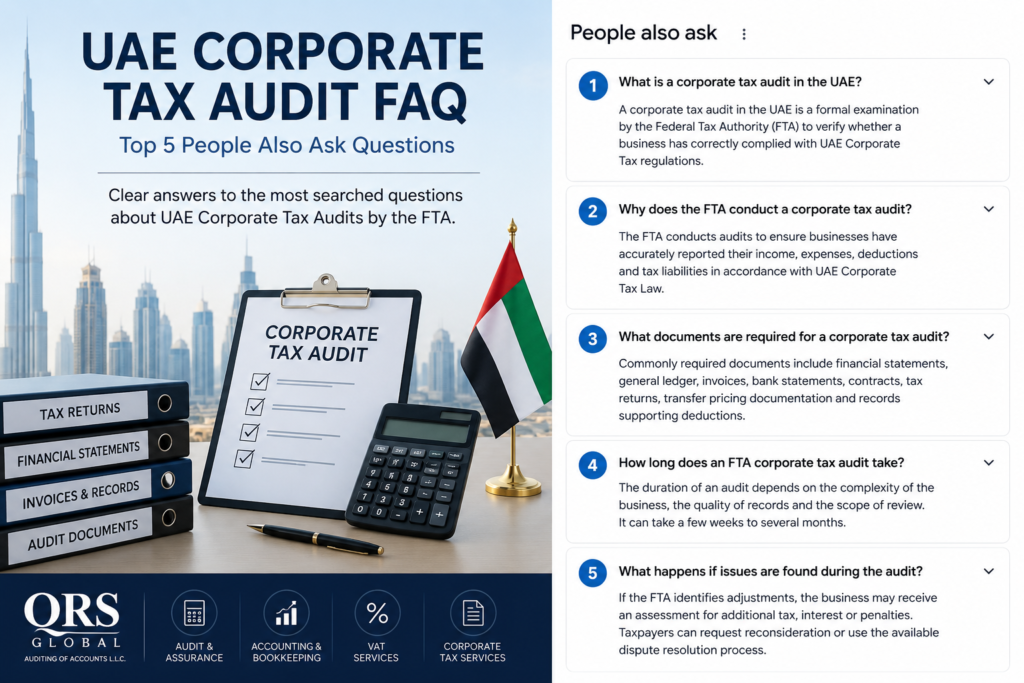
A corporate tax audit in the UAE is a formal examination by the FTA to verify whether a taxpayer has correctly complied with UAE Corporate Tax requirements.
During an audit, the FTA may examine:
- Corporate tax returns
- Financial statements
- General ledgers
- Trial balances
- Sales and purchase invoices
- Bank statements
- Contracts and agreements
- Accounting records
- Related-party transactions
- Transfer pricing documentation
- Records supporting deductions
- Free Zone tax documentation
- Other information relevant to the company’s tax position
The purpose is to establish whether the company’s reported tax position is accurate and supported by appropriate evidence.
Corporate Tax Audit vs Financial Audit
A corporate tax audit is not the same as a financial audit.
A financial audit examines financial statements and provides assurance in accordance with the applicable auditing standards.
An FTA tax audit is a regulatory examination focused specifically on tax compliance.
However, strong accounting records and properly prepared financial statements can make it much easier to support your corporate tax position.
If you need professional financial audit support, you can explore QRS Global’s Auditing Services in Dubai.
How Does the UAE Corporate Tax Audit Process Work?
The exact procedure can vary depending on the taxpayer and the scope of the FTA review.
In general, an FTA corporate tax audit may involve:
Audit notification → Document submission → FTA review → Clarification requests → Possible inspection → Findings/assessment → Reconsideration or further dispute procedures
Let’s look at each stage.
1. FTA Audit Notification
The process can begin when the FTA notifies a business that its tax affairs are being examined.
The notification may identify:
- The tax period under review
- The scope of the audit
- Documents required
- Information requested
- Applicable response requirements
The first step should be to carefully review the notice rather than immediately submitting unorganised documents.
What should you do after receiving an FTA audit notice?
You should:
- Review the audit notice carefully.
- Identify the relevant tax periods.
- Prepare the requested records.
- Reconcile the accounting figures.
- Review the relevant corporate tax return.
- Identify potential inconsistencies.
- Prepare clear explanations.
- Submit complete and properly organised information.
Need help preparing for an FTA audit?
[ SPEAK TO A QRS GLOBAL TAX & AUDIT SPECIALIST ]
2. What Documents Are Required for a Corporate Tax Audit?
There is no single document list that applies to every FTA audit. The documents requested depend on the nature and scope of the examination.
Commonly relevant records include:
Accounting Documents
- General ledger
- Trial balance
- Financial statements
- Bank statements
- Bank reconciliations
- Accounts receivable records
- Accounts payable records
- Fixed asset registers
Revenue Documents
- Sales invoices
- Customer contracts
- Credit notes
- Sales reports
- Revenue reconciliations
Expense Documents
- Purchase invoices
- Supplier agreements
- Payroll records
- Rent agreements
- Professional service invoices
- Supporting documents for deductions
Corporate Tax Documents
- Corporate tax registration information
- Corporate tax returns
- Tax calculations
- Tax reconciliation schedules
- Supporting working papers
Related-Party Documents
Where applicable:
- Related-party agreements
- Intercompany invoices
- Transfer pricing documentation
- Group structure information
- Supporting analysis
Free Zone Documents
Businesses relying on a particular Free Zone corporate tax treatment should maintain appropriate documentation supporting their eligibility and the treatment of their income.
3. FTA Review and Additional Questions
After receiving your records, the FTA may ask additional questions.
This is often where businesses need the most preparation.
A good response should not simply provide a document without explanation.
Instead, the response should establish a clear connection between:
Transaction → Accounting Entry → Tax Treatment → Supporting Evidence
For example, if the FTA asks about a major business expense, your company should be able to identify the invoice, contract, payment record, accounting entry and tax treatment supporting that expense.
This is called maintaining a strong audit trail.
4. Can the FTA Conduct a Field Visit?
Depending on the circumstances, the FTA may conduct an inspection or field visit.
Businesses should therefore be prepared to explain their:
- Business activities
- Accounting systems
- Operations
- Inventory
- Assets
- Contracts
- Financial records
- Relevant tax transactions
It is also useful to designate one person within the company to coordinate FTA communications.
This prevents different employees from providing inconsistent explanations.
5. FTA Findings and Tax Assessment
After reviewing the information, the FTA may identify discrepancies or determine that additional tax or penalties are applicable under the relevant legislation.
Businesses should carefully review any assessment and check:
- Which tax period is affected
- Which transactions were adjusted
- How the adjustment was calculated
- Whether supporting evidence was considered
- The amount of tax involved
- Any applicable penalties
If you believe the assessment is incorrect, don’t ignore it.
UAE tax procedures provide formal mechanisms for challenging certain FTA decisions, subject to the applicable conditions and deadlines.
Can You Dispute an FTA Corporate Tax Audit Result?
Yes, UAE tax legislation provides formal procedures through which eligible taxpayers can challenge certain FTA decisions.
Depending on the circumstances, this may involve:
- Reconsideration
- Tax dispute resolution procedures
- Further court proceedings where applicable
Because tax-dispute procedures can involve strict deadlines and documentation requirements, businesses should obtain professional advice as soon as possible after receiving an adverse decision.
What Can Trigger an FTA Corporate Tax Audit?
There is no publicly available checklist that guarantees whether a business will be audited.
However, companies should pay particular attention to areas that can create compliance questions.
Common Corporate Tax Risk Areas
1. Inconsistent Financial Information
Revenue, expenses and tax calculations should be properly reconciled with the company’s accounting records.
2. Unsupported Expenses
Business expenses should have appropriate supporting documentation.
3. Related-Party Transactions
Transactions with related parties and connected persons may require additional consideration under UAE Corporate Tax and transfer pricing rules.
4. Free Zone Tax Treatment
Free Zone businesses should not automatically assume that all of their income qualifies for a 0% Corporate Tax treatment.
5. Incomplete Records
Missing invoices, contracts or accounting records can make it difficult to substantiate a tax position.
6. Errors in Tax Returns
Incorrect classifications, calculations or unexplained amendments can create additional compliance questions.
How to Prepare for a UAE Corporate Tax Audit
The best time to prepare for an FTA audit is before you receive an audit notice.
Your business should regularly review:
Accounting
- Financial statements
- General ledger
- Trial balance
- Bank reconciliations
- Revenue records
- Expense records
Corporate Tax
- Corporate tax registration
- Tax return
- Tax calculations
- Tax adjustments
- Supporting schedules
If your company has not yet completed its Corporate Tax setup, review QRS Global’s Corporate Tax Registration in UAE guide and services.
VAT
Because VAT and Corporate Tax records can overlap, businesses should also regularly reconcile relevant VAT and accounting information.
QRS Global provides VAT Registration, Filing & Compliance Services in Dubai, including VAT accounting and VAT audit support. Related Parties
Review related-party transactions and determine whether additional transfer pricing documentation is required.
Free Zone
Review your Free Zone Corporate Tax position and maintain evidence supporting the treatment being claimed.
The 48-Hour Corporate Tax Audit Readiness Test
Here’s a simple test every UAE business owner can use:
If the FTA asked for your corporate tax records today, could you quickly locate the documents supporting your major revenue, expenses and tax adjustments?
If the answer is no, your company may need an audit-readiness review.
A practical FTA audit file should contain:
Corporate Tax Return + Financial Statements + Trial Balance + General Ledger + Bank Reconciliations + Invoices + Contracts + Tax Calculations + Revenue Reconciliation + Expense Schedules + Related-Party Documentation
Keeping these records organised throughout the year is much easier than trying to reconstruct them after receiving an FTA notice.
Corporate Tax Audit Services in Dubai and UAE
If you are searching for corporate tax audit services in Dubai, FTA audit support UAE, or professional assistance with corporate tax compliance, QRS Global Auditing of Accounts L.L.C. can help.
Our services can include:
Corporate Tax Audit Readiness
Reviewing your accounting and tax records to identify potential gaps before an FTA examination.
Accounting & Record Review
Checking whether your financial records are complete, organised and suitable for supporting your tax position.
QRS Global also provides Bookkeeping and Accounting Services to help businesses maintain accurate financial records throughout the year.
Tax Reconciliation
Reviewing relevant accounting and tax information to identify unexplained differences.
Documentation Review
Checking invoices, contracts, financial records and other evidence supporting your tax position.
FTA Query Assistance
Helping businesses organise and prepare clear responses to relevant FTA questions.
Audit & Advisory Support
QRS Global’s audit and advisory team provides external audit, internal audit, risk assessment and tax advisory services for UAE businesses.
Why Choose QRS Global Auditing?
An FTA audit is not just about calculating tax.
It is about being able to prove your position with reliable records and supporting evidence.
QRS Global Auditing of Accounts L.L.C. provides businesses with accounting, auditing and tax-compliance support designed around practical business requirements.
Our approach is simple:
Review → Reconcile → Identify Risks → Organise Documents → Prepare → Respond
Whether your company operates in Dubai, Sharjah, Abu Dhabi or another UAE emirate, our team can help you improve your corporate tax audit readiness.
Get Your Corporate Tax Audit Readiness Review
Not sure whether your business is ready for an FTA audit?
Don’t wait until you receive an audit notice.
QRS Global can help you identify potential documentation gaps, reconciliation issues and areas requiring further review.