
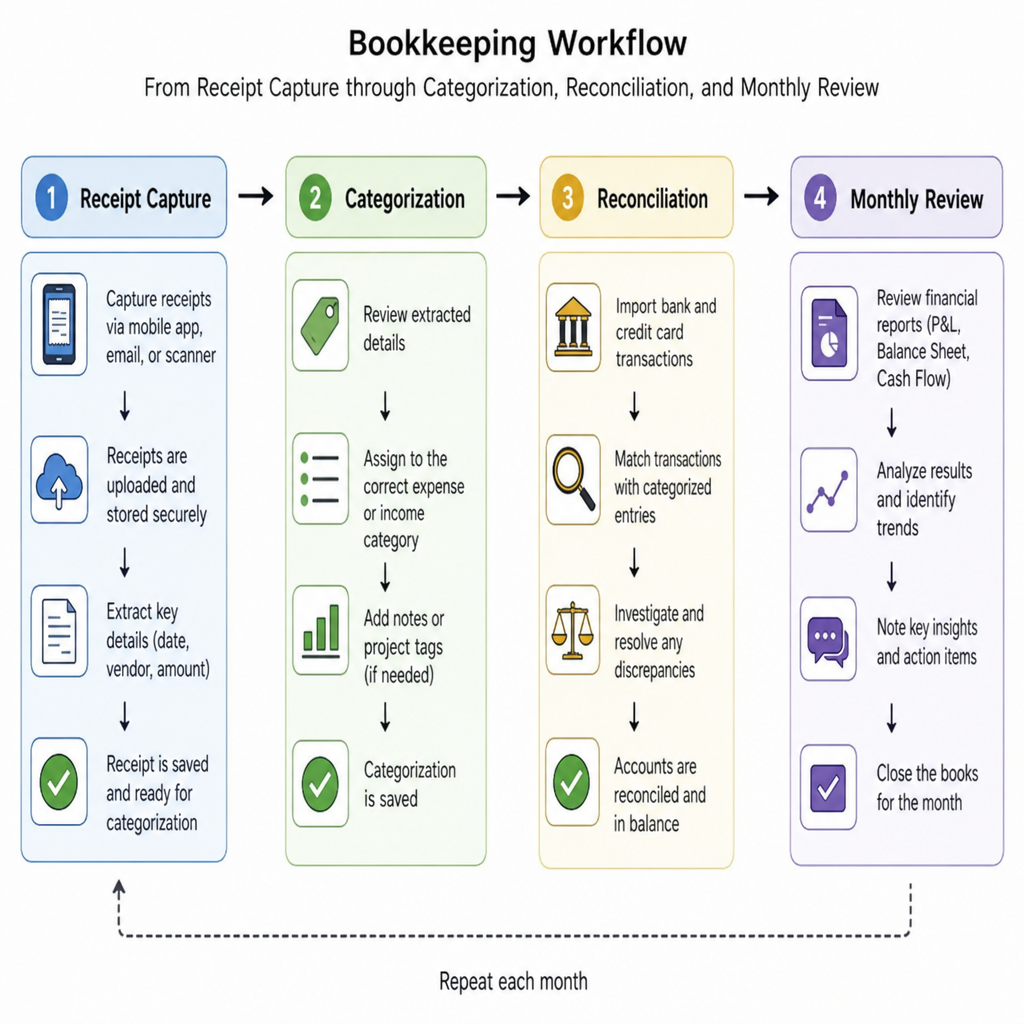
Bank matching means checking your bookkeeping records against bank activity and looking into differences. Regular checks help find missing entries, bank fees, and errors while improving confidence in your records. Include every business bank account and set up a separate review process for cards and payment platforms. (smallbusiness.taxsuperandyou.gov.au)
Use a repeatable sequence instead of changing figures just to make balances fit:
- Confirm the period: compare records that cover the same start and end dates.
- Match transactions: check amounts, dates, references, and supporting documents.
- Investigate unmatched items: look for missing entries, duplicates, fees, or timing gaps.
- Record corrections: explain what changed and keep the evidence.
- Note completion: record who did the check and who reviewed open issues.
For example, if a customer payment shows up in the bank but not on their invoice, check it before recording another sale. Your review should show whether the receipt belongs to an existing invoice, an advance payment, or something else. Escalate unclear treatment instead of choosing the category that only clears the difference.
Establish a weekly and monthly review rhythm
A bookkeeping calendar gives routine work a fixed place in the week. Regularly reviewing customer balances and supplier commitments helps you follow up overdue accounts and understand upcoming payment needs. Adjust the frequency to your transaction volume instead of treating the schedule below as a hard rule. (smallbusiness.taxsuperandyou.gov.au)
| Frequency | Suggested tasks | Review focus |
|---|---|---|
| Daily or often | Capture receipts, record sales, flag unclear entries | Complete supporting evidence |
| Weekly | Review unpaid invoices, upcoming bills, and missing documents | Collection and payment priorities |
| Monthly | Check accounts, review categories, prepare reports | Clear balances and spending changes |
| Before filing deadlines | Review supporting records and open questions with your adviser | Information needed for filings |
At month-end, compare actual spending with your budget and look into meaningful differences. Do not stop at higher or lower costs. Ask whether the change came from planned activity, an unexpected purchase, or a recurring cost that needs a new review. Budget checks are a practical way to turn financial records into management decisions. (business.qld.gov.au)
Keep a short review log with the issue, action, owner, and due date. Check it at the next review so unanswered questions do not drift forward.
Choose software and protect your records
Select bookkeeping tools around your workflow: transaction recording, invoicing, document storage, reporting, and access for your accountant. Digital systems can help with calculations, ledger updates, and financial statements, but features vary. Ask your accountant which functions you need before paying for a package or moving existing records. (business.gov.au)
Test a small sample before you commit. Try entering a supplier invoice, matching a customer receipt, correcting an error, and exporting a report. Also ask how you would retrieve documents and transaction history if you changed providers.
Protect access with unique logins, MFA, suitable user permissions, and regular backups. Remove access when staff leave and test whether key records can be restored. These are practical safeguards recommended in government small-business cyber safety guidance. (cyber.gov.au)
For UAE corporate tax, the Federal Tax Authority says taxable and exempt persons must keep relevant records for at least seven years after the end of the tax period. Check other retention rules before deleting documents. Do not assume every record follows one timetable. (tax.gov.ae)
When should you outsource bookkeeping?
Consider outsourcing when you cannot keep records current, open questions keep growing, or your team needs help building a steady process. Professional support can cover all or part of record keeping, so first list the tasks you need help with. Keep an internal owner responsible for sending documents and reviewing the provider’s work. (smallbusiness.taxsuperandyou.gov.au)
When comparing accounting and bookkeeping companies in UAE markets, ask for a written scope instead of a broad sales pitch. If you need accounting and bookkeeping services in Dubai, state whether you want transaction entry, checks, management reports, tax support, or a mix.
Before choosing an accounting bookkeeping service, ask:
- What is included? Separate routine bookkeeping from extra accounting services and tax work.
- Who checks accuracy? Ask how work is prepared, reviewed, and fixed.
- What must we provide? Agree document deadlines and who handles missing information.
- How will we retain access? Clarify system ownership, exports, document retrieval, and handover steps.
Use the same questions for every shortlisted provider. Compare the proposed work and responsibilities, not just the headline fee.
Put the process into practice
Start with the weakest step in your current routine. That may mean collecting missing receipts, finishing overdue checks, or assigning ownership of customer follow-up. Set a realistic due date, then add the recurring task to your calendar.
Your first goal should be a repeatable monthly cycle: capture, sort, check, review, and fix. Keep a list of exceptions that need professional judgment instead of letting them interrupt every routine entry. Review the process as your transaction volume changes, and update responsibilities when the current setup no longer works.
Q&A
Question: What is the most important first step in improving a bookkeeping process?
Short answer: Start by documenting the process instead of relying on memory. Assign clear responsibility for collecting receipts, entering transactions, approving payments, reviewing records, and escalating unclear items. A simple checklist helps keep the same steps in place when someone is absent or when duties move to another person.
Question: How often should a small business check its accounts?
Short answer: The article recommends a regular rhythm based on transaction volume, with monthly checks as a practical baseline for many businesses. High-volume businesses may need more frequent checks. The key is to compare records with bank activity, investigate unmatched items, record corrections, and note who prepared and reviewed the check.
Question: Why is it risky to mix business and personal transactions?
Short answer: Mixing business and personal transactions makes it harder to identify income and expenses, increases the work needed to prepare financial information, and can create duplicate or unclear entries. If an owner pays a business expense personally, they should clearly flag the transaction, support it with a receipt, and record it according to the accountant’s advice.
Question: What should UAE businesses know about retaining bookkeeping records?
Short answer: For UAE corporate tax, the Federal Tax Authority says taxable and exempt persons must keep relevant records for at least seven years after the end of the tax period. Businesses should also check whether any other retention rules apply before deleting documents, because not every record follows the same schedule.
Question: When does outsourcing bookkeeping make sense?
Short answer: Outsourcing may be right when records are not kept current, open questions keep growing, or the business needs help building a steady process. Even when a provider handles bookkeeping tasks, the business should keep an internal owner responsible for supplying documents, reviewing the provider’s work, and confirming the scope in writing.